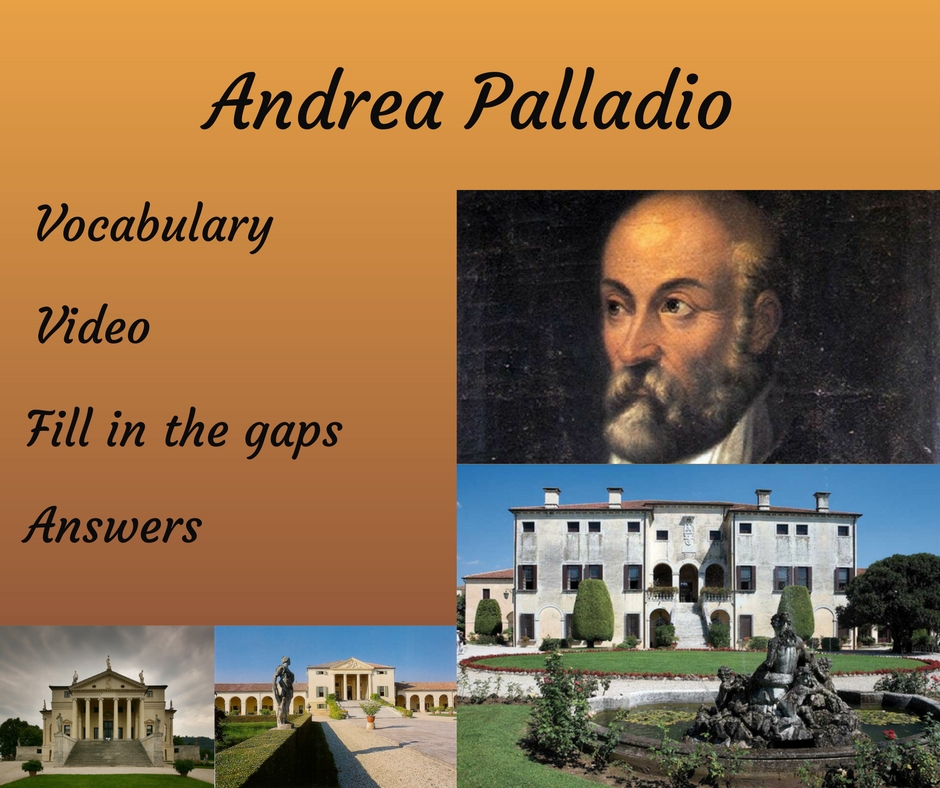
Listening activity – ART/ARCHITECTURE – Andrea Palladio (video by The School of Life)

I’m sorry I haven’t been sharing resources for a while, but I’ve been very busy lately.
This is a listening activity based on the video ‘ART/ARCHITECTURE – Andrea Palladio’ by The School of Life. I suggest that you read the vocabulary list before watching the video. If you want to test your listening skills, try the fill in the gaps exercise below the video, you can also download a printable pdf version.
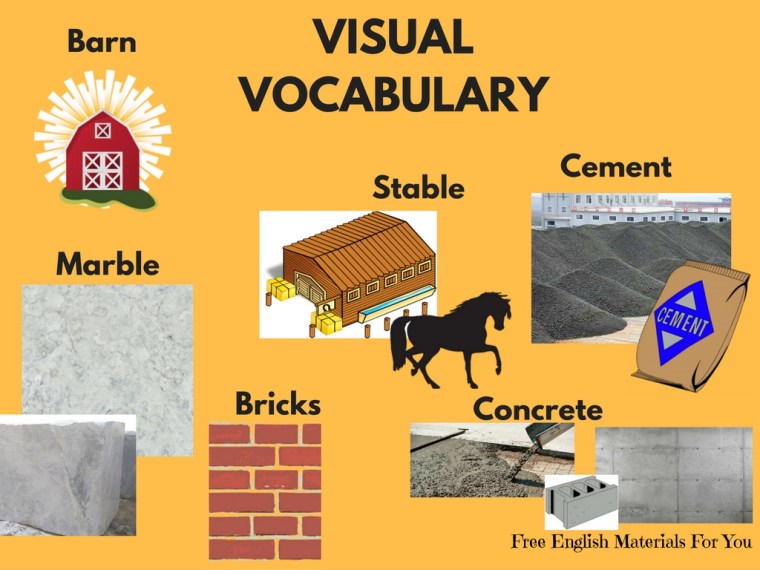
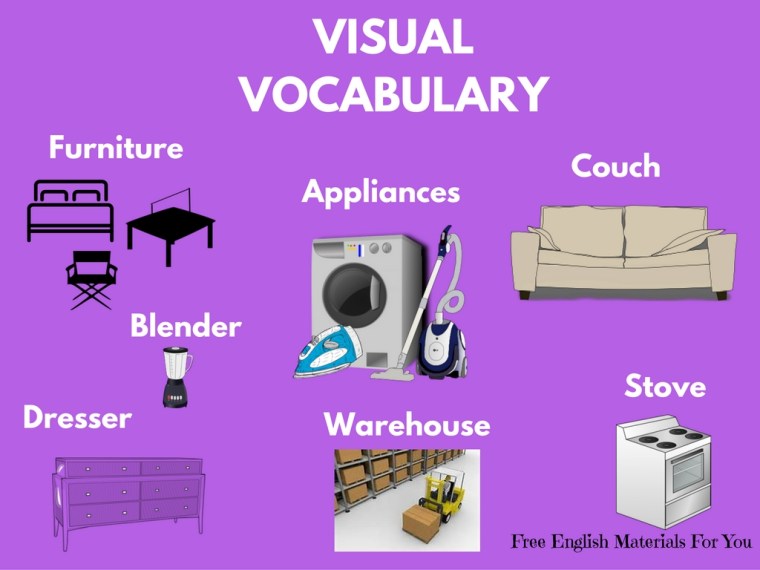
Art_architecture - Andrea Palladio - The School of Life - Visual Vocabulary - Free English Materials For You - femfy

VOCABULARY 

Located: Something or someone that is located in a specified place is in or at that place.
Ex. Our target is located somewhere on the second level.

Stonemason: a person whose job is cutting and preparing stone for buildings.

Stonecutter/ stone carver: a person who cuts or carves stone.

A handful (of somebody/something): a small number of people or things.
Ex. We’ve got a handful of professional soldiers like myself.

Setback: an unanticipated or sudden check in progress; a change from better to worse.
Ex. There has been a slight setback in our plans.

To emerge: to appear by coming out of something or out from behind something.
Ex. A mole emerged from a hole in the ground.

Virtue: a good moral quality in a person, or the general quality of being morally good.
Ex. Patience is a virtue.

Dignity: calm, serious, and controlled behaviour that makes people respect you.
Ex. Try to maintain your dignity, no matter what they call you.

To line up: to form a line; to put into a proper and systematic order.
Ex. They will all have to line up behind you.

Unworthy: lacking merit or value.
Ex. This Tosk is unworthy of such a noble description.

Barn: a large building on a farm where animals, crops, or machines are kept.

Stable: a building where horses or farm animals are kept.

To disguise: to change the usual appearance, sound, taste, etc., of (someone or something) so that people will not recognize that person or thing.
Ex. And I’ve configured the shields to disguise our visual profile.

Utilitarian: designed for use rather than beauty.
Ex. Their furniture was very plain and utilitarian.

To compensate: to provide something good as a balance against something bad or undesirable.
Ex. Nothing will ever compensate for his lost childhood.

Collected: calm and in control of your emotions.
Ex. Even in a life-threatening situation, the captain of the ship was collected.

Poised: showing very calm and controlled behavior.
Ex. Try to be more poised and confident.

Reliably: in a way that you can trust to be accurate.
Ex. Moreover, following this method would require significant adjustments which cannot be reliably quantified.

Distinguished: characterized by excellence or distinction; eminent.
Ex. You’re a government major, inspired by your distinguished aunt.

Cement: a fine grey powder made of a mixture of calcined limestone and clay, used with water and sand to make mortar, or with water, sand, and aggregate, to make concrete.

Harmonious: having a pleasant tune or harmony.
Ex. It will become a harmonious eco-friendly space.

Resonated: to continue to have a powerful effect or value.
Ex. Her speech resonated with voters.

Underlying: used to identify the idea, cause, problem, etc., that forms the basis of something.
Ex. Insomnia may represent an underlying physical or psychiatric disorder.

Advocate: a person who upholds or defends a cause; supporter.
Ex. The European Parliament has always been an advocate of inland navigation.

Downloadable PDF file: Andrea Palladio – Vocabulary

Watch again the video and try to fill in the gaps in the following sentences:

1.   Andrea Palladio was born at the end of November in _______ in Padua.

2.   He was an apprentice ______________ and later stone carver.

3.   Over the next 40 years of his working life, Palladio designed 40 or so villas, a couple of town houses and a ______________  of churches.

4.   For most of his career he had a mix of professional successes and ______________.

5.  Palladio thought we should build in order to ______________  good state of mind in ourselves and others.

6.   All the elements in a room are centered, balanced, ______________.

7.   He only uses simple geometrical ______________. Generally the walls are ______________  and there is little furniture.

8.   Palladio was ______________  with making sure that every element for building fitted perfectly with every other.

9.   One of the ambitions of Palladio’s architecture was to give greater ______________  to parts of life that had been ______________ regarded as unworthy.

10. Rather than being hidden and set at a distance these ______________  buildings are presented as ______________  and important.

11. He wasn’t disguising the ______________  reality of the farm, rather he was demonstrating its ______________  dignity.

12. We need serene ______________  and confident buildings precisely because we’re not reliably like that.

13. Ideally, architecture ______________ our better selves, the ideal building is like the ideal person.

14. There’s a practical guide to digging ______________  and how to judge the quality of cement and the reliable ways of constructing ______________  and laying floors.

15. The fancy surrounds are not the ______________  thing. Without them the window opening will still look ______________.

16. He went on to provide a wide ______________  of rules for making buildings ______________.

17. Palladio saw himself as a ______________, he was simply following a set of rules which others could follow too.

18. He was working against the idea that architecture ______________  a special genius.

19. Buildings are ‘palladium’ when they are devoted to ______________, harmony, and dignity on the basis of rules which can and should be wildly reused.

20. It’s then, they display the same ______________  ambition of which Palladio is a central advocate and ______________.

Downloadable PDF file: Andrea Palladio – Fill in the gaps – Without answers

Downloadable PDF file: Andrea Palladio – Fill in the gaps – Answers

 

Listening activity: “Michigan Resident Helps Syrian Refugees Settle In” – AJ+ video

Michigan Resident Helps Syrian Refugees Settle In - AJ+ Video - Vocabulary List - Listening Activity - Free English Materials For You - femfy(1)

Other words you may not know:

  • Item: an individual thing.
    Ex. An item of clothing.
    An item of furniture.
  • To resettle: to begin to live in a new area after leaving an old one; to settle again.
    Ex. The only way to resettle a Mexican family here is by granting them political asylum.

Watch the video, then try to fill in the gaps in the following sentences:

  1. We give them as much ______________ as we can that they need, depending on how many people are in the house.
  2. We give them ______________, and stoves if they are needed.
  3. We’d been  able to work with these _________________.
  4. They come ___________ to our houses, meet our parents, meet our kids.
  5. They feel that they have a sense of family _____________ because most of these families have been _________________.

Downloadable PDF file: Michigan Resident Helps Syrian Refugees Settle In – Listening Activity

Downloadable PDF file: Michigan Resident Helps Syrian Refugees Settle In – Listening Activity – answers


Attack in Nice: Lorry driver confirmed as Mohamed Lahouaiej-Bouhlel – BBC News

Another terrible mass murder took place yesterday in Nice (France). Below the BBC video confirming the identity of the lorry driver responsible for killing all these people:

Words you may not know:

  • Promenade: seaside walking path.
  • To piece together: to bring together (various parts or pieces) to form one complete thing.
  • Fingerprint:
    thumbprint-md.png
  • Lorry: 

lorry-th.png

  • To throw a light: to clarify something; to provide an explanation for something.
  • Abominable: very bad; horrible; abhorrent; unpleasant.
  • Odd: strange or unexpected.
  • To slam: to shut (close something) with force and loud noise.
  • Frankly: in an honest and direct way. 
  • Delivery driver: a person who delivers goods to customers.
  • Petty crime: a type of crime that is not considered serious when compared with some other crimes; minor offences.
  • Breakdown: a typically sudden collapse (failure) in physical or mental health.
  • Mass murder: the act of killing a lot of people.

Listening Activity – Jane Austen

This is a listening activity based on The School of Life’s short video (about 7 minutes long) “LITERATURE – Jane Austen”. This activity is aimed at students who have an English level between B2 and C1 (Upper Intermediate and Advanced).

I suggest that you read the following vocabulary list before watching the video. Under the video, there are two exercises (with answers) and a writing practice suggestion. 

VOCABULARY 

  • AMBITIOUS: having a desire to be successful, powerful, or famous; having ambition.
    Ex. She was ambitious enough to aim for the company’s presidency.
     
  • STERN: very serious; severe.
    Ex. Journalists received a stern warning not to go anywhere near the battleship.
     
  • CONSCIOUS: awake, thinking, and knowing what is happening around you.
    Ex. When I took the exam, I was conscious that my parents were expecting a lot of me.

  • DIGNIFIED: serious and somewhat formal; having or showing dignity.
    Ex. Even when very old, he was very dignified in appearance.

  • WELL OFF: moderately rich.
    Ex. They must be well off if they can afford to buy a house there!
     
  • TEMPTED: to want something or to want to do something.
    Ex. “Would you like some more pie?” “I’m tempted, but no thank you.”

  • STRUGGLE: a long effort to do, achieve, or deal with something that is difficult or that causes problems.
    Ex. The people of this country will continue in their struggle for independence.
     
  • TO CONDEMN: to say in a strong and definite way that someone or something is bad or wrong.
    Ex. We strongly condemn this attack against our allies.
     
  • TO OVERCOME: to prevail over (opposition, a debility, temptations, etc.); surmount.
    Ex. To overcome one’s weaknesses.

  • INCOME: money that is earned from work, investments, business, etc.
    Ex. He has a very high annual income.
     
  • TO FELL APART: to break into pieces (often used figuratively).
    Ex. I feel as if my family is falling apart.
     
  • TO SUPPLY: to furnish or provide (something wanting or requisite).
    Ex. To supply a community with electricity.
     
  • WEALTH: a large amount of money or valuable possessions that someone has.
    Ex. The wealth of a city. 
  • ELUSIVE: hard to find or capture.
    Ex. Police are trying to track down the elusive criminal, who has so far avoided all their attempts to capture him.

  • SNOBBISH: like a snob (a person who respects and likes only people who are of a high social class).
    Ex. He’s a snobbish rich kid.

  • GREED: a selfish desire to have more of something (especially money).
    Ex. He was a ruthless businessman, motivated by naked ambition and greed.

Downloadable PDF version: JANE AUSTEN – Vocabulary

Watch the video and answer the following questions

  1. Austen wanted to change people with her novels. How did she want them to become?
  2. When is Jane Austen born and where?
  3. How was the writer’s family social status?
  4. Did she get married?
  5. What’s Jane’s sister name?
  6. How many novels did Jane complete?
  7. What are the titles of the novels she completed?
  8. What are the four main things Jane Austen wanted to teach us?
  9. In Jane Austen’s opinion marriage depends on two factors, do you remember them?
  10. Name the two mistakes people make around money according to Jane Austen.

Writing practice suggestion

  1. Write Jane Austen’s main opinions concerning love, marriage, judging people, money, and being snobbish. Do you agree or disagree with the writer?
    Justify your answer.

Downloadable PDF version: Jane Austen – Listening comprehension

Downloadable PDF version: Jane Austen – Listening comprehension with answers

Watch the video then fill in the gaps in the following sentences

  1. Jane Austen is loved mainly as a guide to fashionable life in the _____________ period, but her own vision of her task was radically different.
  2. She was an ambitious and ______________ moralist.
  3. Born in _____________, Austen grew up in a small village in Hampshire, where her father was the Anglican _________________.
  4. She did much of her writing at a ______________ octagonal table.
  5. The _______________ was her chosen weapon in the struggle to reform humanity.
  6. ________________ starts of feeling superior because he has more money and higher status.
  7. The story ______________ them because they have developed well.
  8. ______________________________ starts when quiet, shy Fanny Price goes to live with her much richer cousins, the Bertrams.
  9. In Pride and Prejudice, she explains that Mr. _________________ has an income of _________________ pounds a year –that’s rather a lot- while Darcy has more than twice that.
  10. At one point in _______________________________, it looks like Elinor Dashwood and Edward Ferrars who are otherwise well suited won’t be able to get married.
  11. In Emma, the heroine –Emma herself- takes ______________________ -a pretty girl from the village- under her wing.

Downloadable PDF version: Jane Austen – Fill in the gaps exercise

Downloadable PDF version: Jane Austen – Fill in the gaps exercise answers


Everyday objects, tragic histories by Ziyah Gafić – Listening activity

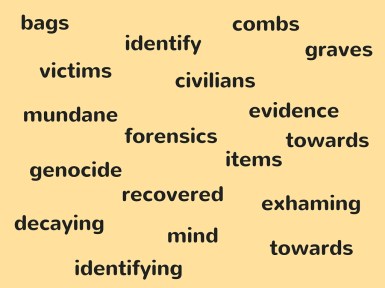
Vocabulary list

COMB          pink-comb-clipart-1

GENOCIDE: the deliberate killing of people who belong to a particular racial, political, or cultural group.

MUNDANE:  common; ordinary; banal; unimaginative.
Ex. Mundane matters such as paying bills and shopping for food do not interest her.

ABOUT + INFINITIVE: very close to doing something.
Ex. The chorus is about to sing.

TO RECOVER: to get back something lost or spent.
Ex. We have to recover the stolen watch.

GRAVE: a hole in the ground for burying a dead body.

CIVILIAN: a person who is not a member of the police or the armed forces.
Ex. What is more, bombs have been directed at civilian targets, in flagrant violation of the international humanitarian law.

FORENSICS: the study or science of solving crimes by using scientific knowledge or methods.

TOWARDS: in the direction of.
Ex. The bus is heading towards town.

REMNANT: the part of something that is left when the other parts are gone.

TO FADE: to (cause to) lose colour, brightness, or strength gradually.
Ex. These dreams of yours fade like smoke.

EVIDENCE: material that is presented to a court of law to help find the truth about something.

OUT OF SIGHT OUT OF MIND: The idea that something is easily forgotten or dismissed as unimportant if it is not in our direct view.

UNBIASED: fair; impartial.
Ex. By all accounts, Mr. Smith appears to be an unbiased expert in his field.

AWARENESS: knowledge that something exists, or understanding of a situation or subject at the present time based on information or experience.
Ex. To do this requires considerable awareness and commitment.

TO DECAY: to become decomposed; rot; to deteriorate.
Ex. The bodies buried in the fine ash slowly decayed.

Downloadable PDF version:EVERYDAY OBJECTS, TRAGIC HISTORIES – Ziyah Gafić – TED Talks – Vocabulary

 Video without subtitles:
https://embed-ssl.ted.com/talks/ziyah_gafic_everyday_objects_tragic_histories.html

Video with English subtitles:
https://embed-ssl.ted.com/talks/lang/en/ziyah_gafic_everyday_objects_tragic_histories.html

Fill in the gaps in the following sentences with the correct words from the box

Box - words (6)

1.      These are simple objects: clocks, keys, ________________, glasses. 
2.      We are all familiar with these ________________, everyday objects.
3.      The fact that some of the ________________ carried personal ________________ such as toothpaste and a toothbrush is a clear sign they had no idea what was about to happen to them.
4.      These items have been recovered from numerous mass ________________ across my homeland, and as we speak, forensics are ________________bodies from newly discovered mass graves, 20 years after the war.
5.      During the four years of conflict that devastated the Bosnian nation in the early ’90s, approximately 30,000 citizens, mainly ________________, went missing, presumed killed, and another 100,000 were killed during combat operations.
6.      Most of them were killed either in the early days of the war or________________the end of the hostilities, when U.N. safe zones like Srebrenica fell into the hands of the Serb army.
7.      The international criminal tribunal delivered a number of sentences for crimes against humanity and ________________.
8.      Genocide is not only about the killing; it is about the denied ________________.
9.      These items are ________________ from numerous mass graves, and the main goal of this collection of the items is a unique process of ________________ those who disappeared in the killings, the first act of genocide on European soil since the Holocaust.
10.  Thousands of artifacts are packed in white plastic ________________ just like the ones you see on CSI. These objects are used as a forensic tool in visual identification of the victims, but they are also used as very valuable forensic ________________ in the ongoing war crimes trials.
11.  Once the ________________ and doctors and lawyers are done with these objects, they become orphans of the narrative. Many of them get destroyed, believe it or not, or they get simply shelved, out of sight and out of ________________.
12.  Once all the missing persons are identified, only ________________ bodies in their graves and these everyday items will remain.

Downloadable PDF version (without answers): EVERYDAY OBJECTS, TRAGIC HISTORIES – Ziyah Gafić – Fill in the gaps

Downloadable PDF version (answers):EVERYDAY OBJECTS, TRAGIC HISTORIES – Ziyah Gafić – TED Talks – Answers

“The Story Behind Your Bowl Of Ramen Noodles” – AJ+ – Listening comprehension

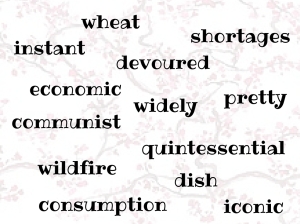
This is a listening activity based on the AJ+ video “The Story Behind Your Bowl Of Ramen Noodles”. I suggest that you read the following vocabulary list before watching the video. Then, watch the video and try to complete the sentences with the correct word from the box.

VOCABULARY

Bowl: purple-bowl-th.png

Migrant: a person who goes from one place to another especially to find work.
Ex. Economic migrants move abroad to escape poverty and improve their financial condition.

Labor: workers considered as a group.
Ex. We had this huge harvest, so we had to hire all this cheap labor.

Shortage: a state in which there is not enough of something that is needed.
Ex. In many European countries, agricultural businesses complain about the shortage of skilled workers.

Wheat: wheat.png

Consumption: the act of eating or drinking something.
Ex. Alcohol consumption constitutes a major danger to road safety.

Uprising: an act of resistance or rebellion; a revolt.
Ex. He weighed 38 kilos when he escaped from prison during the 1956 Hungarian uprising and fled to the Netherlands.

To lead: to lie or go in a specified direction.
Ex. This way will lead us to the main entrance for sure.

Affordable: inexpensive; reasonably priced.
Ex. Railways have many benefits, as travelling by rail is affordable and environmentally friendly.

Lifestyle: the way a person lives or a group of people live.
Ex. Technology, the internet, they have changed our lifestyle.

Quintessential: the most important part of something.
Ex. Sheep’s milk cheese is the quintessential Corsican cheese.

Dorm: informal, short for dormitory.

dormitory

Image source

Wildfire/ like wildfire: (informal) very quickly.
Ex. The news had spread like wildfire.

To devour: eat hungrily or quickly.

devouring meaning

Image source

Downloadable PDF version: The Story Behind Your Bowl Of Ramen – Vocabulary

Fill in the gaps in the following sentences with the correct word from the box

Box - words

  1. This signature Japanese ___________ is now an international favorite.
  2. Ramen as we know it comes from Japan but its popularity in the country is actually ___________ new.
  3. Then Japan entered World War II which led to major food ___________ across the country and ramen’s popularity pretty much disappeared. 
  4. When the war ended the US occupied Japan and imported a whole lot of wheat to the country, leading to more noodle _____________________.
  5. And one reason why there was so much ______________ imported was because there was a fear that food shortages could lead to _________________uprising.
  6. After those really hard times, from the 1950s to 1970s Japan went through an _____________________ boom.
  7. And busy lifestyles led to the creation ________________ ramen in the 1950s.
  8. Then in the 1970s the super convenient just add water ________________ dorm food cup of noodles was made and it took off like ________________ in Japan and internationally. 
  9. But it wasn’t until the 1980s that ramen actually became an_______________  part of Japanese culture.
  10. Today the love for ramen is real in Japan and what was once a working men’s food is now a ___________________ love and __________________ dish around the world.

Downloadable PDF version (without answers): The Story Behind Your Bowl Of Ramen Noodles – AJ+ – Fill in the gaps exercise

Downloadable PDF version (answers): The Story Behind Your Bowl Of Ramen Noodles – AJ+ – Exercise’s answers

Why are we wasting so much food? – Listening activity

Vocabulary

Wealthy: having a lot of money and possessions.
Ex. The fisheries sector may experience temporary crises even in some relatively wealthy countries.

To struggle: to experience difficulty and make a very great effort in order to do something.
Ex. The police report even said that she struggled with her assailant and broke a few fingernails.

To afford: to be able to buy or do something because you have enough money or time.
Ex. Tom told me that he couldn’t afford another divorce.

Deprivation: a  situation in which you do not have things or conditions that are usually considered necessary for a pleasant life.
Ex. She is studying the effects of sleep deprivation.

To feed: to give food to.
Ex. I usually feed the neighbour’s cat while she’s away.

Malnourished: not eating enough food or not eating enough healthy food.
Ex. Malnourished children experience developmental delays, weight-loss and illness as a result of inadequate intake of protein, calories, and other nutrients. 

Fossil fuel: any combustible organic material, as oil, coal, or natural gas, derived from the remains of former life.
Ex. Brown coal is the only source of fossil fuel available in Slovenia.

Blemished: to make (something) imperfect or less beautiful; to hurt or damage the good condition of (something).
Ex. The book is blemished by those long, ineffective descriptions.

Supplier: a company, person, etc. that provides things that people want or need, especially over a long period of time.
Ex. Electricity customers should be able to choose their supplier freely.

To dump: to throw away or discard (garbage, etc.).
Ex. The company dumped the toxic wastes into this canal.

To overflow: to flow over the edge or top of (something).
Ex. The river overflowed its banks.

Complicit: involved with others in reprehensible or illegal activity.
Ex. She was accused of being complicit in her husband’s death.

To use up: to finish a supply of something.
Ex. I’m sorry, I’ve used up all the milk.

Dumpster: a large metal container into which people put unwanted objects or building or garden waste, and which is brought to and taken away from a place by a special truck when people ask for it.
Ex. I found your dad’s toolbox in the dumpster out back.

539870869_0fa759215b_z.jpg

Image source

To toss: to throw, esp. lightly or carelessly.
Ex. She came in and tossed her coat on the chair.

Retailer: a person or business that sells things directly to customers for their own use.
Ex. The company is a leading retailer of women’s clothing.

Livestock: the horses, cattle, sheep, and other useful animals kept or raised on a farm or ranch.
Ex. This is a market where livestock is bought and sold.

 19845895095_9a12a7b963_z.jpg10833422624_b470969ae9_z.jpg5790983557_41bbe9921a_z.jpg
Image sources: 1; 2; 3


Subsidy: money that is paid usually by a government to keep the price of a product or service low or to help a business or organization to continue to function.
Ex. The planned subsidy is EUR 3.3 million.

Downloadable PDV version: Why are we wasting so much food – vocabulary – Free English Materials For You


Answer the following questions:

  1. How much food does the world waste?
  2. What do you need to grow food?
  3. What are the foundations of our food system?
  4. Why can’t farmers sell all of what they have grown?
  5. What is the image created by supermarkets?
  6. How are redistributed some of this nutritious surplus?
  7. How should governments use the subsidies they offer?

Downloadable PDF version (without answers): Why are we wasting so much food? – Listening Comprehension

Downloadable PDF version (with answers): Why are we wasting so much food? – Vocabulary

Fill in the gaps in the following sentences with the correct words from the list below:

 retailers – 30% – overflowing – wealthiest – fossil fuels – subsidies – feed – tossed – struggle – consumption – grown – customers – farmers – 1982 – wasted – tossing

  1. Even in the _____________nations millions suffer from food poverty.
  2. One in four Americans says they _________________to afford food.
  3. Over  _________________ of America’s food or a hundred and sixty billion dollars worth get _________________ just by grocery stores and their customers.
  4. Growing food demands land, water, ________________, and soil.
  5. The tragedy is that some farmers can’t sell half of what they’ve____________ due to cosmetic standards dictated by supermarkets.
  6. Supermarkets purposefully create an image of                                        
  7. […] meanwhile, over cautious date labels confused and frightened ______________ so they                                 out what is still good to eat.
  8. From _____________to 2002, the average pizza slice grew 70% in calories and the average chocolate chip cookie quadrupled.
  9. Food donations from                          and restaurants are proven ways of redistributing some of this nutritious surplus while is still fit for                                       .
  10. Instead of ________________ this food, supermarkets manufactures and caters must be pushed to directed charities that _____________ hungry people.
  11. Governments should use the vast ______________ they offer to incentivize                            to look after the land in ways that protect the planet.

Downloadable PDF version (without answers): Why are we wasting so much food? – Fill in the gaps exercise (without answers)

Downloadable PDF version (answers): Why are we wasting so much food? – Fill in the gaps exercise (answers)


Burning Millions’ Worth of Illegal Ivory

I suggest that you read the vocabulary list before watching the video ;-):

https://www.facebook.com/plugins/video.php?href=https%3A%2F%2Fwww.facebook.com%2Fajplusenglish%2Fvideos%2F725281944279982%2F&show_text=0&width=560

VOCABULARY

TUSK => a very long, large tooth that sticks out of the mouth of an animal (such as an elephant, walrus, or boar)

tusk.jpg
TO GO UP IN SMOKE => to burn up completely

to go up in smoke meaning.jpg

Image source

STOCKPILE => a large supply of something that is kept for future use

stockpile meaning.jpg
TO TORCH => to set fire to (something, such as a building) deliberately : to cause (something) to burn
TRADE => the activity or process of buying, selling, or exchanging goods or services
STUNT => something that is done to get attention or publicity
TO BAN => to forbid, to prohibit; to say that something cannot be used or done
TO POACH => to hunt or fish illegally

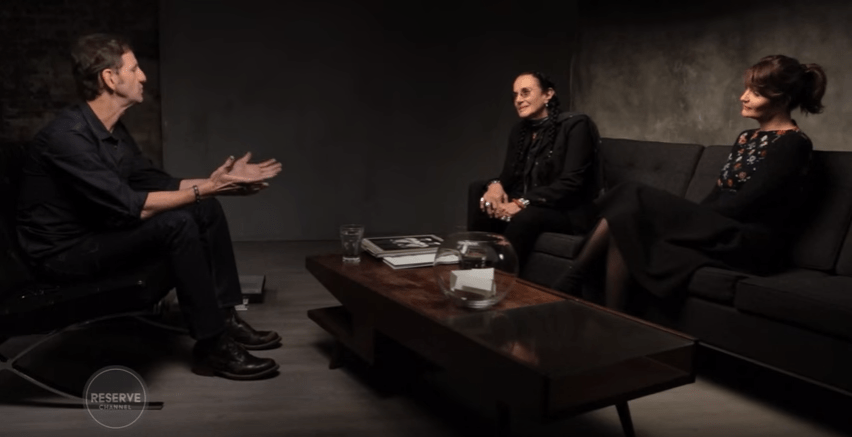
Helena Christensen & Portrait Photographer Mary Ellen Mark Capture™ – Episode 7 LISTENING ACTIVITY

I suggest that you read the vocabulary list below before watching the video.

VOCABULARY


Hitch – hiking: to get a ride in a passing vehicle by holding out your arm with your thumb up as you stand on the side of the road.hitchhiking.gif


Scope:
the area or amount covered, reached, or viewed.
Ex. Romance questions are beyond the scope of the language forum.

Standstill: a condition in which all movement or activity has stopped.
Ex. This is an emergency, but the negotiations are at a virtual standstill.

Creepy:   strange or scary : causing people to feel nervous and afraid.
Ex. This is the creepy stalker woman from the surveillance video.

 To broom: to sweep the floor with a broom.

to broom meaning.jpg

To kick in: to start to have an effect or to happen.
Ex. The effects of the tranquilizer should begin to kick in within a few minutes.

Harsh: cruel or unkind.
Ex. She was quite harsh with the kids. She should be nicer to them.

Guarded: very careful about giving information, showing feelings, etc.

Vocal: expressing opinions and complaints in a public and forceful way.
Ex. Residents became vocal in their opposition to the plan.

To blow up: to make a photographic enlargement of.

Dull: boring, not exciting or interesting.

To tear up: to damage, remove, or effect an opening in.

Mind-blowing: extremely exciting or surprising.
Ex. The special effects in this film are pretty mind-blowing.

Goosebumps: small bumps on your skin that are caused by cold, fear, or a sudden feeling of excitement.

Downloadable PDF file: Helena Christensen & Portrait Photographer Mary Ellen Mark Capture™ Ep. 7 – VOCABULARY

Fill in the gaps in the following sentences:

  1. Helena Christensen: I ____________________ around the world when I was about 18-19 years old and I think my interest and passion for photography probably started on that trip. And then almost immediately that trip ended my _______________ _________________ started and so then I got to see the world.
  2. Voice-over: I’ve had the rare opportunity to meet many amazing photographers who moved through the different _________________ to create powerful images.
  3. Mark Seliger: I’m here with Mary Ellen Mark photojournalist and portrait photographer ___________ work has changed, I think, the _________ of modern photography.
  4. Mark Seliger: It was very ________________ to me because there was photojournalism but there was also this very ____________ and creative way that images were presented.
  5. Mary Ellen Mark: Magazines were like ______________ for me, they gave me this amazing opportunity to do my own work.
  6. Helena Christensen: When I’m behind the camera I seem to stop breathing because I get so ______________ by the moment. It’s almost like everything just came to a standstill.
  7. Mary Ellen Mark: The guy that ran the ______________ … We called him doctor death.
  8. Helena Christensen: You know what is strange about this photo? I don’t even know where I took it and the negative was ______________ together with a piece of paper so when I _______ it ____________ obviously all that white stuff which looks like ice on a window […].
  9. Helena Christensen: We don’t live in these areas so we are not ______________ the same ways. When you are in it, you feel it in a way that’s inexplicable.
  10. Helena Christensen: And it was one of those moments when you are like … your adrenaline … just … you know … __________ ________, because you’re like … oh, this is one of those.
  11. HelenaChristensen: It’s very harsh as Mary Ellen was saying. People are very ______________, more and more.
  12. Helena Christensen: That’s kind of what I feel you do with your portraits. You get the ___________ essence of these people no matter of how they are dressed up, no matter how they’re made up. You go right through to the _____________ of them.
  13. Mary Ellen Mark: When you are working with an actor you have to __________ control.
  14. Mary Ellen Mark: I think I have so much stronger pictures. For some reason, that picture became an ____________ picture.
  15. Helena Christensen: It’s very important and I feel with contact sheets which we are now losing because no one ever get contact sheets back anymore and sits with 24 or 26 images. But now that I _______ __ _____ at my old contact sheets, I see something completely different in some of the photographs that I would have never even … you know … been the least excited about maybe fifteen years ago …I’m now … Why didn’t I __________ this up?!?
  16. Mary Ellen Mark: Right when I was taking that picture the ____________ of the high school walked in … I thought he was gonna like throw me out … But he didn’t.

Downloadable PDF file (without answers):Helena Christensen & Portrait Photographer Mary Ellen Mark Capture™ – Episode 7 FILL IN THE GAPS

Downloadable PDF file (ANSWERS):Helena Christensen & Portrait Photographer Mary Ellen Mark Capture™ – Episode 7 ANSWERS

A brief history of video games (part 1) – Safwat Saleem – video + fill in the gaps exercise

VOCABULARY

  • Interface: a system that is used for operating a computer.

  • To spread: to become known by many people.
    Ex. The news spread quickly.

  • Patent: an official document that gives a person or computer the right to be the only one that makes or sells a product for a certain period of time.

  • Mouthful (US): something said that has a lot of meaning or importance.

  • To wonder: to want to know something or to try to understand the reason for something.
    Ex. I wonder if she’ll call him.

  • Release: the act of making something available to the public.
    Ex. The release of her article for publication is scheduled for tomorrow.

  • Hit: success
    Ex. The song is a hit.

  • To heat up: to increase or become more active or intense.

  • To feature: to include someone or something as an important part.
    Ex. I consider the measures featured in the report to be insufficient.

  • To kick off: to begin, to get started.
    Ex. The game kicks off at 2:00.

  • Milestone: an important event in the development or history of something or in someone’s life.
    Ex. Your poem will be a milestone in the literature of your Country.

  • Damsel in distress (old-fashioned): a young woman who is not married and needs to be rescued.

  • Sales: the number of items sold.

  • Merely: only, just.
    Ex. It was merely a suggestion.

Downloadable PDF file: A brief history of videogames (part 1) – Vocabulary

Here you can watch this video with subtitles: Ted Ed

Fill in the gaps in the following sentences with the correct form of the words from the vocabulary list written above:

  1. In 1972, Bear’s idea to get video games out of the science lab and into the living room led to the _____________ of a game console called Odyssey.

  2. A video game is an electronic game that has an ______________ designed for human interaction on a video device.

  3. Space Invaders also helped ____________ what is known as the Golden Age of Arcade Games.

  4. In fact, the earliest U.S. video game ______________ on record was in 1948, and at the time it was referred to as a cathode-ray tube amusement device. That’s a ______________ !

  5. This all changed when a man named Ralph Baer looked at his television screen and ______________ how else it might be used.

  6. By 1978, competition between Atari and another game company called Midway was _______________.

  7. While arcade games continued to decline in ________________ over the years, the popularity of video games was ________________ beginning […].

  8. By 1980, color came to arcade games, and this was also the year that another video gaming _________________ was born.

  9. It was an immediate ___________________ and it’s credited as the first commercially successful video game.

  10. Video games are used by scientists, the military, and people like you, and their evolution has ________________ across arcades, consoles, computers, smartphones, and all kind of other electronics.

  11. It was released in 1987 and, like Donkey Kong, it ___________________ a _______________________ storyline, a storyline common in many video games.

Downloadable PDF file: A brief history of videogames (part 1) – Fill in the gaps exercise with answers

Answers: 

1) Release; 2) interface; 3) kick off; 4) patent; mouthful; 5) wondered; 6) heating up; 7) sales; merely; 8) milestone; 9) hit; 10) spread; 11) featured; damsel in distress.