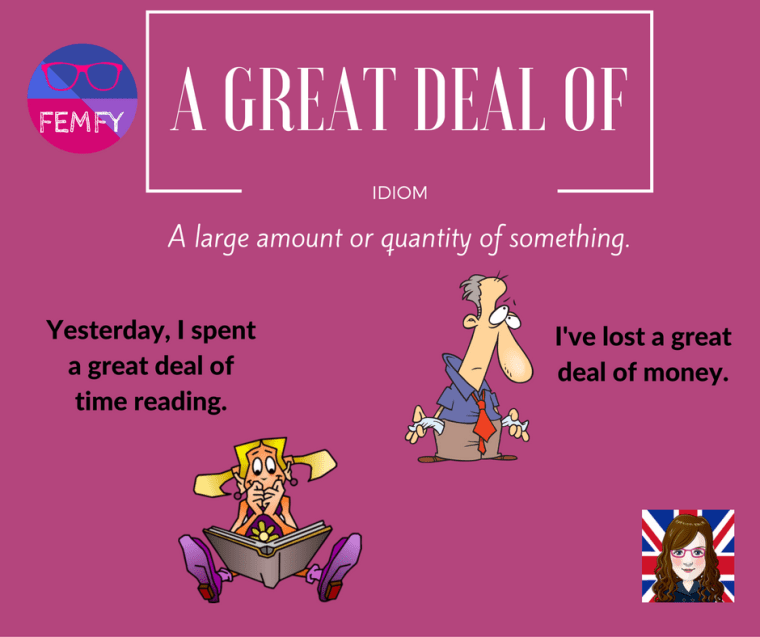
“A great deal of something” – Example sentences from the web:
How to Succeed at Science—and at Life
[…] What advice would you give would-be scientists today?
It’s been a long time since anybody’s tried to marginalize me around a gender issue, but I am sensitive to the fact that for young women it’s not always easy still. And so I take a great deal of pleasure in trying to be supportive and encouraging, particularly when I think young women—and young men too, frankly—have a hard time seeing that they can become successful scientists and have a family life as well. […] National Geographic, published May 15, 2015
Exploring the Roots of Grayson Perry and His Varied Artwork
[…] Charles Saumarez Smith, secretary and chief executive of the Royal Academy of Arts in London, the 247-year-old artist-run institution to which Mr Perry was elected in 2011, said he viewed Mr Perry “more as a graphic artist than as a potter,” describing him as “a first-rate printmaker of extraordinary invention and imagination, with a great deal ofintelligent social commentary.” […] By Farah Nayeri, The New York Times, published June 3, 2015
Introduction to Marketing
[…] Generally, in good economic times, there is a great deal of demand, but this introduces a fear of possible inflation. In the U.S., the Federal Reserve will then try to prevent the economy from “overheating.” This is usually done by raising interest rates. This makes businesses less willing to invest, and as a result, people tend to make less money. During a recession, unemployment tends to rise, causing consumers to spend less. This may result in a “bad circle,” with more people losing their jobs due to lowered demands. Some businesses, however, may take this opportunity to invest in growth now that things can be bought more cheaply. […] By Lars Perner, Ph. D., Assistant Professor of Clinical Marketing , Department of Marketing , Marshall School of Business, University of Southern California , Los Angeles
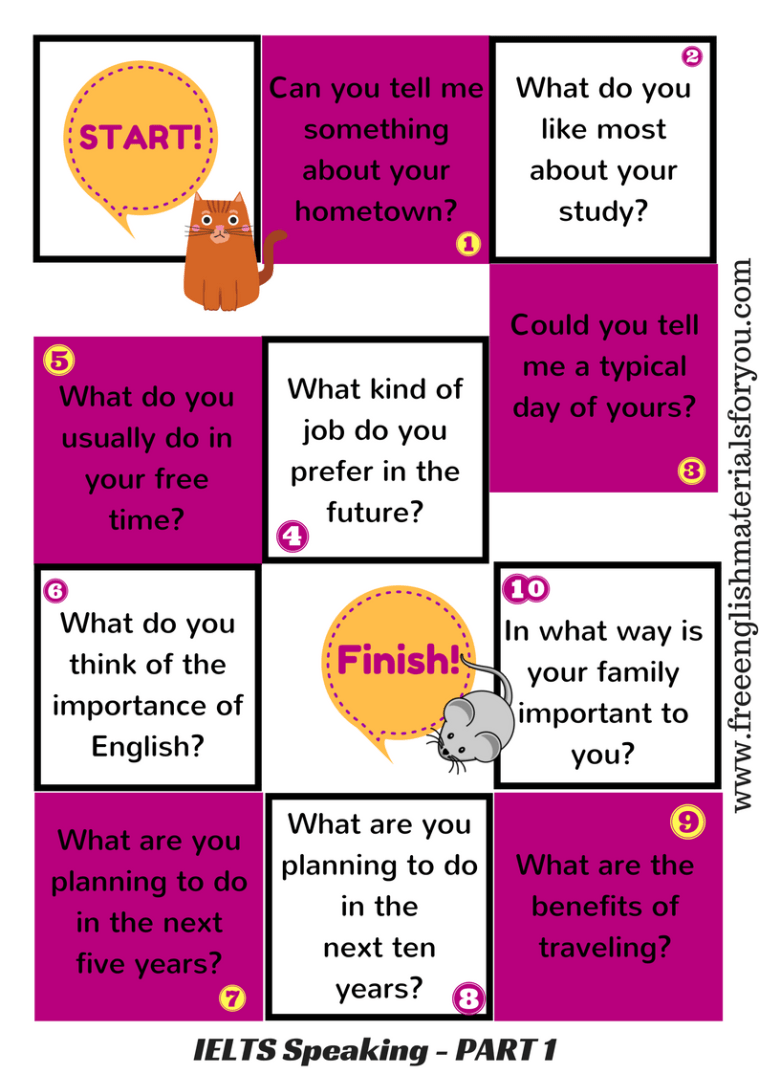
I created this board game for a student who’s getting ready for the IELTS test. I found all the questions here: http://www.ielts-exam.net/. I hope you’ll find it useful ;-).
I’m currently teaching English to a 15-year-old girl and she is fond of gymnastics. This is why I’m teaching her English with Make it or Break it, an American television drama series set in the world of competitive gymnastics. Usually I make a vocabulary list for her, than we watch 15 minutes of one episode without subtitles. While we’re watching I ask her questions in order to check if she’s understanding everything. Then I give her 10-15 sentences with some gaps she’s to fill in and two sentences to translate from Italian into English. After learning English with this method for one year she got a B2 certification, so I must say I’m proud of her and I verified this is actually an effective method. Of course, I’m not just teaching her English with this TV series. Sometimes, we read newspaper articles or we watch a TED-Ed video, etc. but in my opinion, teaching with TV series is the most effective way to get teenagers focusing on learning English without getting stressed. She is not getting bored and she’s learning kind of easily.
Season 2, episode 8:
TO BE ON THE FENCE => unable to decide about something.
Another example sentence:I was on the fence till you showed up, but thanks for helping me decide.
Season 2, episode 9:
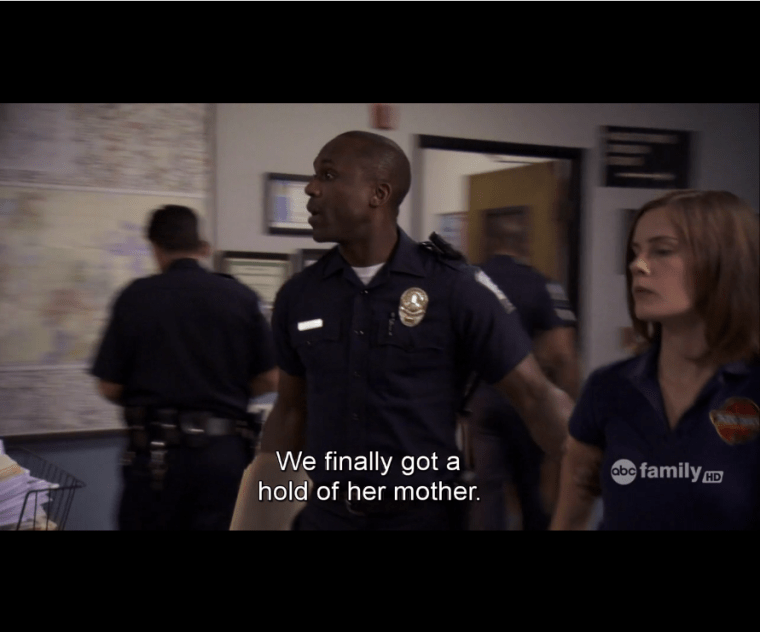
To get hold of somebody: to contact or find somebody.
Another example sentence: I got hold of the father, and he said the boy wasn’t there, and he doesn’t know about this yet.
Yesterday I watched this interesting video by National Geographic on Halloween so I decided to share it with you. As always you’ll find a vocabulary list below and a comprehension activity. I hope you’ll enjoy it :-).
VOCABULARY
COMMUNION (with somebody/something): the state of sharing or exchanging thoughts and feelings; the feeling of being part of something.
Ex. Many people who live in close communion with nature are superstitious.
PRANK: a trick that is done to someone usually as a joke.
Ex. Jackie’s pranks were starting to annoy her colleagues.
PATCHWORK: a thing that is made up of many different pieces or parts.
Ex. So the world is this complex patchwork of regions.
OCCULT: magic or supernatural.
TO STITCH WITH: to make (something) out of many different things
Ex. They stitched red and blue ribbons onto their hats.
TO SPAN: to last for a particular period of time, especially a long period.
Ex. His career spanned half a century.
TO SPREAD: to cover, or to make something cover, a larger and larger area.
Ex. The European flu continues to spread throughout the UK.
VEIL: something that covers or hides something else.
TO GATHER: to bring (things or people) together into a group.
Ex. The children gathered their toys (together) and put them away.
TO FROWN ON SOMEBODY/SOMETHING: to disapprove of somebody/something.
Ex. The company frowns on dating among employees.
TO MERGE: to combine or make two or more things combine to form a single thing.
Ex. He has plans to merge his own company with anotherone.
DECEASED: dead; no longer living.
THE FOLD:a group of people with whom you feel you belong or who share the same ideas or beliefs.
Ex. We are hoping that these policies will bring reluctant voters back to the fold.
FAMINE: a situation in which many people do not have enough food to eat.
EXTORTION: the crime of making somebody give you something by threatening them.
BRIBE: something valuable (such as money) that is given in order to get someone to do something.
I suggest that you check the vocabulary list before reading the article ;-). If the article is too difficult for you, you can also use Rewordify to read a simpler version of it.
VOCABULARY
NESTLED: to be located in a position that is protected, sheltered or partly hidden. Ex. And while the compound, nestled on the remote shores of Lake Nipissing, was his entire world.
DISPOSABLE: made to be used once or only a few times.
INCOME: money that is earned from doing work or received for investments.
INCREASINGLY: more and more all the time. Ex. Global warming is an increasingly serious threat.
TO FLOCK: to gather or move together somewhere in large numbers.
Ex. The people that flocked to that motorcycle to help him get a chance of doing the GrandPrix, they saw that he was something special.
PROLIFERATION: to increase a lot and suddenly in number. Ex. Gun proliferation is a global problem.
PACKAGE TOUR: a group of services related to travel or vacations that are sold together for one price.
FIGURE: a number representing a particular amount, especially one given in official information.
TO FATHOM: to come to understand.
Ex. I thought I had a lifetime to fathom the secrets in your eyes.
WINDSWEPT: not protected from strong winds.
TO PERMEATE: to spread to every part of an object or a place.
Ex. The water permeated the sand.
GREEDY: having or wanting a lot more money, food, etc. than you need.
HERDER: a person who take care of a large group of animals of the same type.
SUBSIDY: money that is paid usually by a government to keep the price of a product or service low or to help a business or organization to continue to function.
Ex. The federal government gives us a subsidy for each person that completes the training.
Nestled high up in the Indian Himalayas, Ladakh was first opened up to tourists only in 1974. That year, just 527 visitors made the trip; of these, only 27 were from India. But in recent years, with rising disposable incomes and a growing interest in travel, Indians are increasingly flocking to the region’s high-altitude villages,…
DAYCARE: a place, program, or organization that takes care of children or sick adults during the day usually while their family members are at work.
SCREENING: the testing or examining of a large number of people or things for disease, faults, etc.
PROBING: to ask a lot of questions in order to find secret or hidden information about someone or something.
LOUSE (Plural => LICE): a type of small insect that lives on the bodies of people or animals.
CHILD SEAT:
TODDLER: a child who has only recently learnt to walk.
Watch the video then answer the following questions:
Before entering, Maggie tried to catch: – a ladybug – a butterfly – a dragonfly
Marge has left Maggie at the daycare. How was she feeling in that moment: – scared – happy – bored
What did Maggie leave in the box? – a ball, a set of keys, and a pacifier. – a set of keys, a doll, and a pencil. – a set of keys, a pacifier, and a blue bow.
Did Maggie end up in the gifted area? – Yes, she did. – No, she didn’t.
Maggie tried to get some paints, what colours did she get? – yellow and black – brown and white – grey and black
Another toddler scared her. He was hitting butterflies with – a box – a hammer – his hand
Maggie tried to save: – a warm – a snake – a caterpillar
The scary child was chasing Maggie. What did stop him at first? – a teacher – a toy train – an animal
What did Maggie try to do right after that? – to use the telephone – to hide from the scary child – to hit the other child
In the room full of children on their walkers, what did Maggy break? – a window – a balloon – a vase
Who was playing the drums? – a child – a bear – a monkey
How did Maggie manage to save the butterfly? – she put the butterfly in her pocket – she swapped the butterfly with her blue bow. – she threw the butterfly out of the window
Complete the following sentences with the correct words:
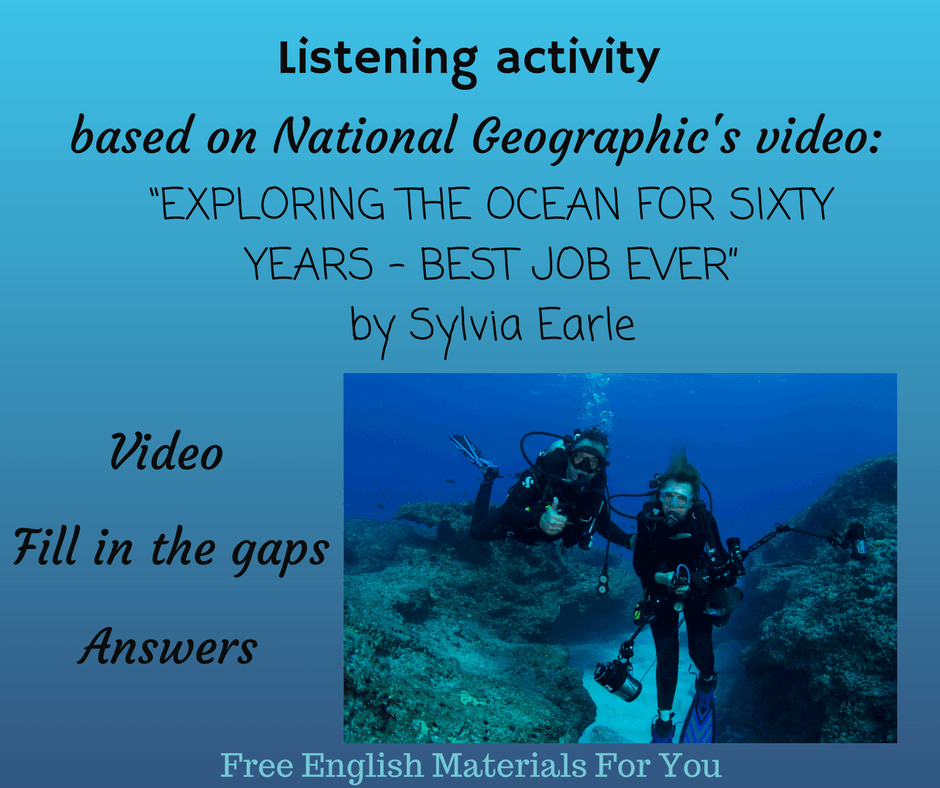
Even if you_______________________ (to see- never) the ocean or touch the ocean touches you.
Every breath you take, every ______________ of water you drink it’s the ocean.
For me ___________________ (to be) a biologist just ____________________ (to follow) my heart ____________________ (to lead) me to some fascinating places.
As a scientist I love nothing more than being an explorer ____________________ (to discover) the nature of life itself, that sense of eureka.
It’s a wonderful passport _______________ the ocean.
We are just beginning to assess the magnitude of out ignorance and at the same time that we’re learning more, we’re also discovering how much we_________________________ (to lose).
How do you save the ocean? You find others who __________________ (to have) a similar goal.
All of us depend on these _______________________ and they’re incredibly …. In some ways they’re incredibly ______________________ if we do the right thing but they’re also …
It’s a magical sight that endless horizon that just _____________________ (to stretch) out to blue infinity.
You jump in the ocean and there you find ___________________________.
Yesterday, I came across this Ted-Ed video and I found it quite informative. It’s just 5 minutes long and it isn’t difficult to understand. As you can guess reading the heading, it’s about GLUTEN, allergies, and intolerances. On Ted-Ed‘s website, you can find other listening activities on the video.
Below a vocabulary list you should read before watching the video:
Maybe you’ve recently seen the phrase “gluten-free” on food ________________, or take-out menus, shampoo bottles, apartment listings, the _______________of your shirt, on a hammer, as a lower back tattoo, or in your friend’s resume.
Next time someone starts telling you about their newfound freedom from gluten, here are some questions you can ask, and the _________________ answers that your friend, being a reasonable individual making educated _________________choices, and by no means just following the latest diet _________________, will tell you.
What is gluten? Gluten is an insoluble protein composite _________________ of two proteins named gliadin and glutenin.
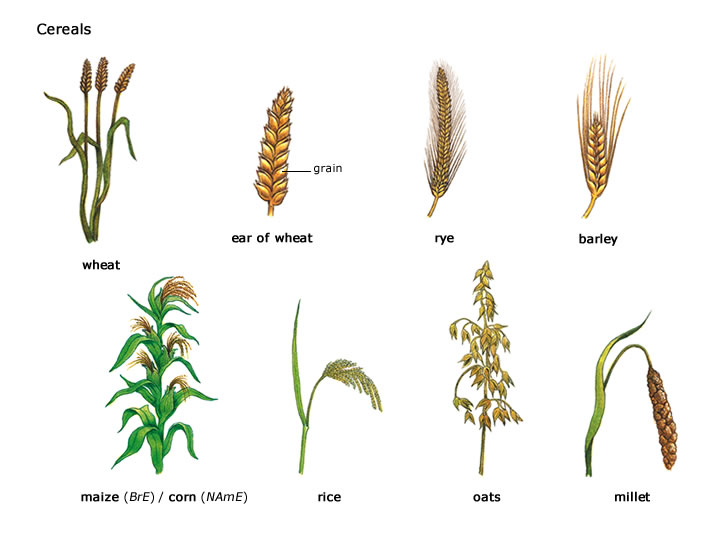
Gluten is found in certain grains, particularly wheat, rye and _______________ .
Gluten is responsible for the elastic consistency of and the chewiness of _______________ foods made from wheat flour, like bread and pasta.
For some people, these foods cause problems, namely wheat allergy, celiac _________________, and non-celiac gluten sensitivity.
Wheat allergy is an uncommon _________________ that occurs when a person’s immune system _________________an allergic response to wheat proteins, leading to mild problems, and in rare cases, a potential dangerous reaction called anaphylaxis.
Celiac disease is an _________________ disease, in which eating foods with gluten leads to inflammation and damage of the lining of the small intestine.
This impairs intestinal function, _________________ to problems like belly pain, bloating, gas, diarrhea, weight loss, skin _________________, bone problems like osteoporosis, iron deficiency, small stature, infertility, fatigue and depression.
Celiac disease is present in one in every 100 to ____________persons in the U.S.
The most effective _________________ is a gluten-free diet, which helps heal intestinal damage and improve symptoms.
Gluten sensitivity’s _________________ in the general population is unclear, but likely much more common than wheat allergy or celiac disease.
For example, it may be the case that gluten can activate the immune system in the small intestine, or cause it to become _________________.
The human intestine can’t _________________ or absorb fructans, so they make their way to the large intestine or colon, where they’re fermented by bacteria, producing short-chain fatty acids and gases.
Another possible explanation behind gluten sensitivity is the ________________ effect. This occurs when a person believes something will cause problems, and because of that belief, it does. It’s the opposite of the more well-known and much more ____________________ placebo effect.
So a better name than non-celiac gluten___________________might be wheat _____________________.










 Free English Materials For You