

Tag: English
Days of the week and verbs related to daily activities (for beginners).
This video is designed for students, teachers and anyone wanting to learn English.
This is the content:
DAYS
Sunday, Monday, Tuesday, Wednesday, Thursday, Friday, Saturday.
ACTIVITIES
Do laundry
Take out the trash
Go to the gym
Go to the supermarket
Go bowling
Take out the recyclables
Go hiking
On Sunday
On Monday
On Tuesday
On Wednesday
On Thursday
On Friday
On Saturday
On Sundays, I do my laundry.
On Mondays, I take out the trash.
On Tuesdays, I go to the gym.
On Wednesdays, I go to the supermarket.
On Thursdays, I go bowling.
On Fridays, I take out the recyclables.
On Saturdays, I go hiking.
How about you?
What do you do on Sundays?
What do you do on Mondays?
What do you do on Tuesdays?
What do you do on Wednesdays?
What do you do on Thursdays?
What do you do on Fridays?
What do you do on Saturdays?
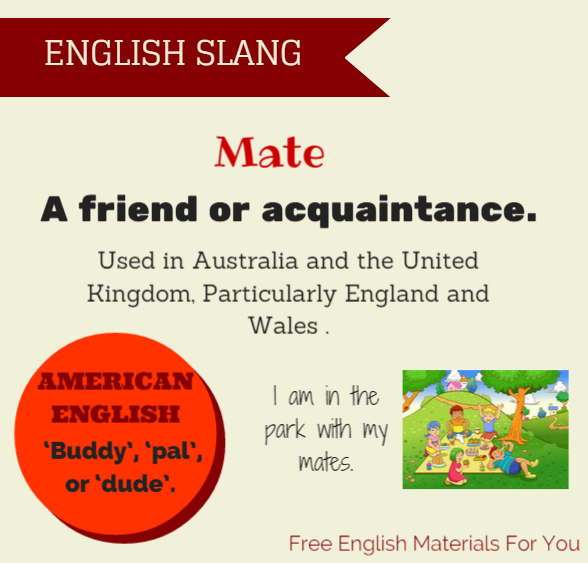
“Mate” – English slang
“Dig in your heels” – English idiom

Conjugation of the verb “to dig“.
Examples from the web:
– Even though the developer offered them more than their houses were worth, the owners dug their heels in and refused to sell up and make way for the office block.
– I’m digging in my heels. I’m not going back.
5 ‘world’ English idioms
5 “world” English idioms video
1) They’re on top of the world since they had a baby.
=> They are extremely happy about it.
=> IDIOM: to be on top of the world.
2) I think the world of my parents.
=> I value and respect them.
=> IDIOM: to think the world of someone.
3) Nothing much. Just sitting here watching the world go by.
=> I am doing almost nothing, I’m just sitting around.
=> IDIOM: to watch the world go by.
4) He had the whole world at his feet by the time he was 30.
=> He had become extremely successful, popular and admired.
=> IDIOM: to have the world at your feet.
5) Congratulations on your new job. You’re really moving up in the world.
=> You are becoming more and more successful.
=> IDIOM: to move up in the world.
“Fork in the road” – English idiom

Image source: http://spiritualhealingsource.com/wp-content/uploads/2013/09/fork-in-the-road-what-now.jpg
Examples:
- After graduating from university, I reached a fork in the road when I had to decide between doing a Ph.D. in Literature, or to find a job. It took me months to decide!
- There is a fork in the road, do I follow his advice or hers?
“Ace” – English slang

This slang expression is used in English meaning mostly “awesome”, “cool”, “excellent”.
Ex. Your shirt is so ace! I love it!
Furthermore, it can be used to refer to a very skilled person, expert, adept.
Ex. My grandfather was a World War I ace pilot.
Andrew is an ace mechanic, he repaired my car in one hour.
It means also “the best”, deriving from aces, the highest cards in poker and other card games.
Ex. That new CD is ace. I’m so glad I bought it, I’m listening to it over and over again.
In addition, you could use “ace” referring to someone who is really close to you, a person you can relate to.
Ex. That’s my ace! She’s my best friend.
As a verb (to ace), it’s used to talk about someone who accomplished something with complete success.
Ex. He’s a champion who could ace it every time.
She aced her entrance exams.
“Advertisement” – What does it mean?

“A hot potato” – English idiom

Agreeing or disagreeing in English – Second version
Someone asked me to make this mind map with a bigger font size. On my computer, I created it as imx file (you can download it from biggerplate.com).Unfortunately, only with iMindmap you can read imx files and I know that not everyone has it. The only thing I can do with mind maps is to use a screen capture program and post them as images. Unfortunately, when I make big mind maps, with a lot of branches, I can’t use a big font size. Consequently, some people could find it difficult to read them. What I can do for them is to write as a normal post what is written in the mind map. If you have any other suggestion, I always welcome new ideas ;-).
By the way, if you click on the mind map image you have the possibility to zoom a little bit.
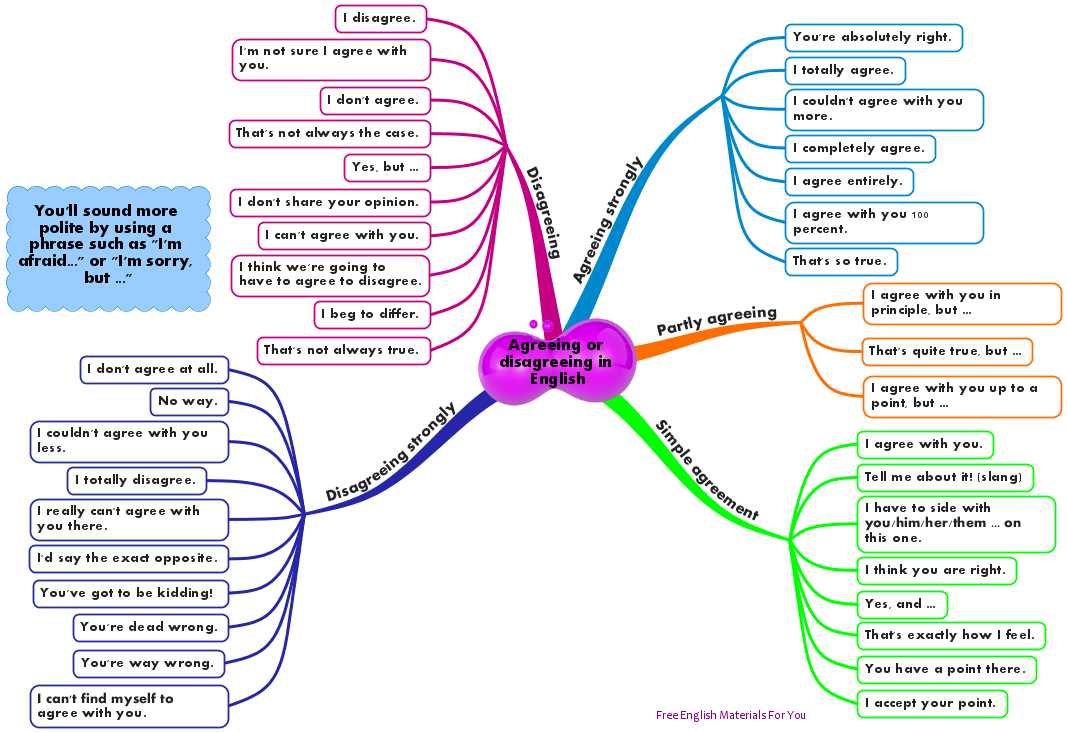
AGREEING OR DISAGREEING IN ENGLISH
Simple agreement:
- I agree with you.
- Tell me about it! (slang)
- I have to side with you/him/her /them … on this one.
- I think you are right.
- Yes, and …
- That’s exactly how I feel.
- You have a point there.
- I accept your point.
Partly agreeing
- I agree with you in principle, but …
- That’s quite true, but …
- I agree with you up to a point, but …
Agreeing strongly
- You’re absolutely right.
- I totally agree.
- I couldn’t agree with you more.
- I completely agree.
- I agree entirely.
- I agree with you 100 percent.
- That’s so true.
Disagreeing
- I disagree.
- I’m not sure I agree with you.
- I don’t agree.
- That’s not always the case.
- Yes, but …
- I don’t share your opinion.
- I can’t agree with you.
- I think we’re going to have to agree to disagree.
- I beg to differ.
- That’s not always true.
Disagreeing strongly
- I don’t agree at all.
- No way.
- I couldn’t agree with you less.
- I totally disagree.
- I really can’t agree with you there.
- I’d say the exact opposite.
- You’ve got to be kidding!
- You’re dead wrong.
- You’re way wrong.
- I can’t find myself to agree with you.
You’ll sound more polite by using a phrase such as “I’m afraid …” or “I’m sorry but …” before disagreeing or disagreeing strongly.
 Free English Materials For You