
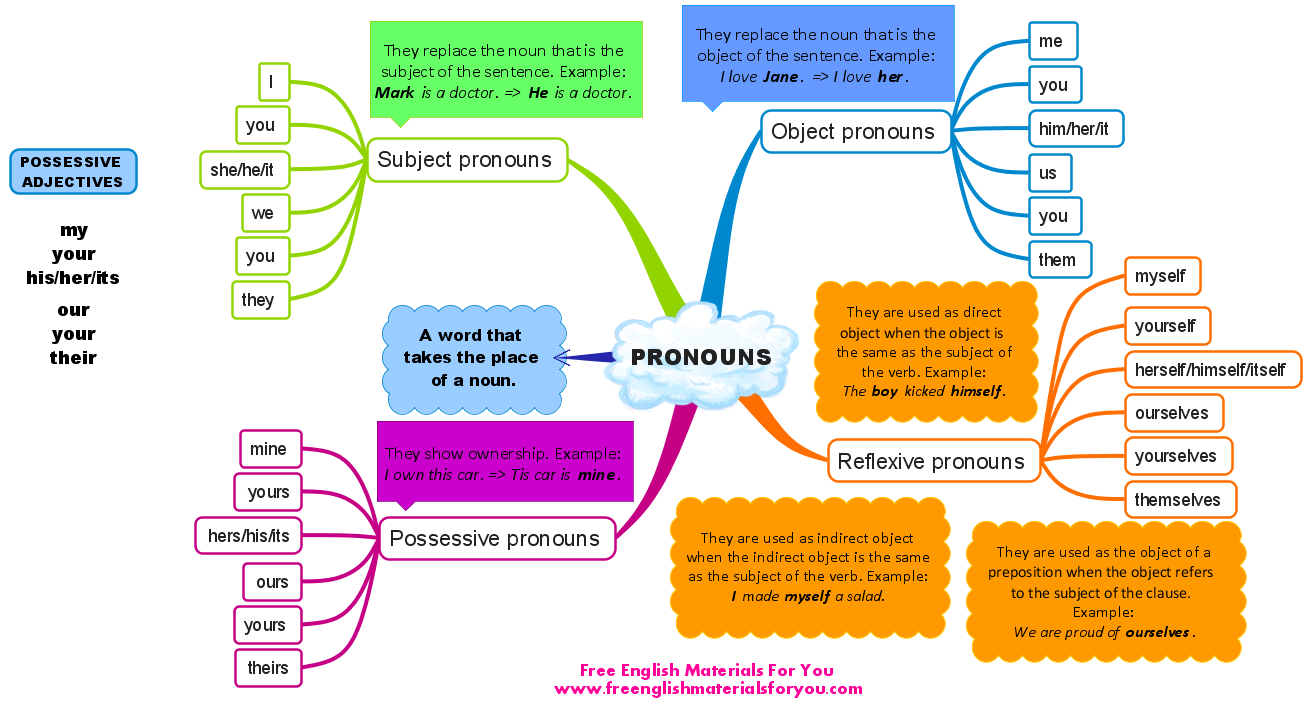
 You can download this mind map as imx. file on Biggerplate or as pronouns_in_english_mind_map file.
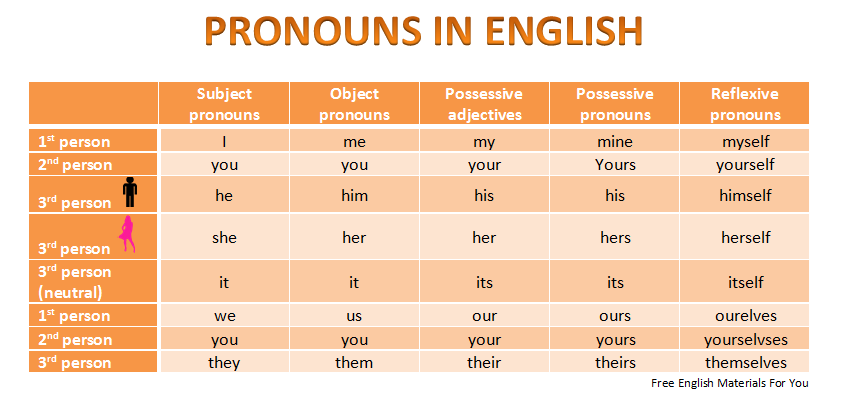
You can download this mind map as imx. file on Biggerplate or as pronouns_in_english_mind_map file.
 Based on: McCarthy, M. O’Dell, F. (2008), Collocations in use, Cambridge: Cambridge University Press.
TO END
TO FINISH

Conjugation of “TO COME“. (link)
EXAMPLES FROM THE WEB
COME ALONG => Arrive at a place
– Go now and I will come along later.
– He decided to give the money to the first stranger who came along.
– Even if another job comes along this summer, I won’t take it.
COME OUT => Disappear or become less strong (of dirt or colour on clothing/material)
– We scrubbed the carpet with soap but the stains still wouldn’t come out.
– Let your dress soak overnight and the stain will probably come out.
COME OUT => Become public knowledge after it has been kept secret (of the truth)
– The truth is beginning to come out about what happened.
– The news of her death came out last week.
COME OUT OF => Leave after a period in a place (of hospital/prison)
– After three years, she came out of the coma.
– Mandela came out of prison after 27 years of captivity.
– The criminal came out of the house with arms raised.
COME OUT => Be given to people (of results or information)
– When do your exam results come out?
– Elections were held in Albania on 2 July and the results came out on 2 September.
COME APART => Separate into pieces
– It came apart when I tried to lift it off the floor and I had to glue it back together.
– The artery that is bringing blood to your brain, it’s coming apart.
– The doll just came apart when touched.
COME AROUND/ROUND => Become conscious again
– The unconscious patient finally came around.
– My sister was with me when I came round after the operation.
Here you can download the mind map (imx file).

EXAMPLES FROM THE WEB
COME ABOUT => Happen, especially something that is not planned
– How did such a mess come about, anyway?
– How did this quarrel come about?
– I truly believe that the integration of the European Union cannot come about if we do not proceed rapidly to unify rules relating to justice.
COME OFF => Happen successfully, or as planned
– I was surprised when the plan came off so easily.
– To everybody’s astonishment, the scheme came off.
– She didn’t come off well in that interview.
COME UP => Mentioned or discussed
– Your name came up in conversation.
– If the subject of Nobel Prizes comes up, maybe you could drop something about my nomination.
COME UP => Happened unexpectedly, usually a problem or difficult situation
– I’ll be late home tonight because something’s come up at work has to be ready for tomorrow morning.
– I’m sorry, but something came up at home and I couldn’t finish my homework.
– I’m the one who promised to take her to the theater, but then something came up.
COME UP=> Become available
– And when the PE vacancy came up, she suggested Jason.
– Now, there had been some rumors that if a vacancy came up on the Supreme Court, that LBJ might appoint me.
– A full-time opening came up, and Jack gave the job to his son.
Here you can download this mind map (imx file).

EXAMPLES FROM THE WEB
COME UP AGAINST => Encountered or have to deal with (a difficult situation)
– The negotiations came up against stumbling blocks on several points.
– I’ve never come up against anything I can’t handle.
– Two years ago, the Amsterdam Council already came up against this problem and did not manage to solve it.
COME TO => Make (a decision about something)
– I’ve got to come to a decision.
– Everybody in the school comes to that conclusion?
– In 1992, the French came to a decision on the basis of spurious information.
COME ACROSS => Discover (or met) by chance
– I came across my old school reports when I was clearing out my desk.
– Recently, I’ve come across some useful information.
– He’s the most brilliant student I’ve come across.
COME DOWN TO => Depend mostly on or be influenced most by
– I guess in the end my decision will come down to what my professor recommends.
– It all comes down to a question of who tries hardest.
Someone asked me to make this mind map with a bigger font size. On my computer, I created it as imx file (you can download it from biggerplate.com).Unfortunately, only with iMindmap you can read imx files and I know that not everyone has it. The only thing I can do with mind maps is to use a screen capture program and post them as images. Unfortunately, when I make big mind maps, with a lot of branches, I can’t use a big font size. Consequently, some people could find it difficult to read them. What I can do for them is to write as a normal post what is written in the mind map. If you have any other suggestion, I always welcome new ideas ;-).
By the way, if you click on the mind map image you have the possibility to zoom a little bit.
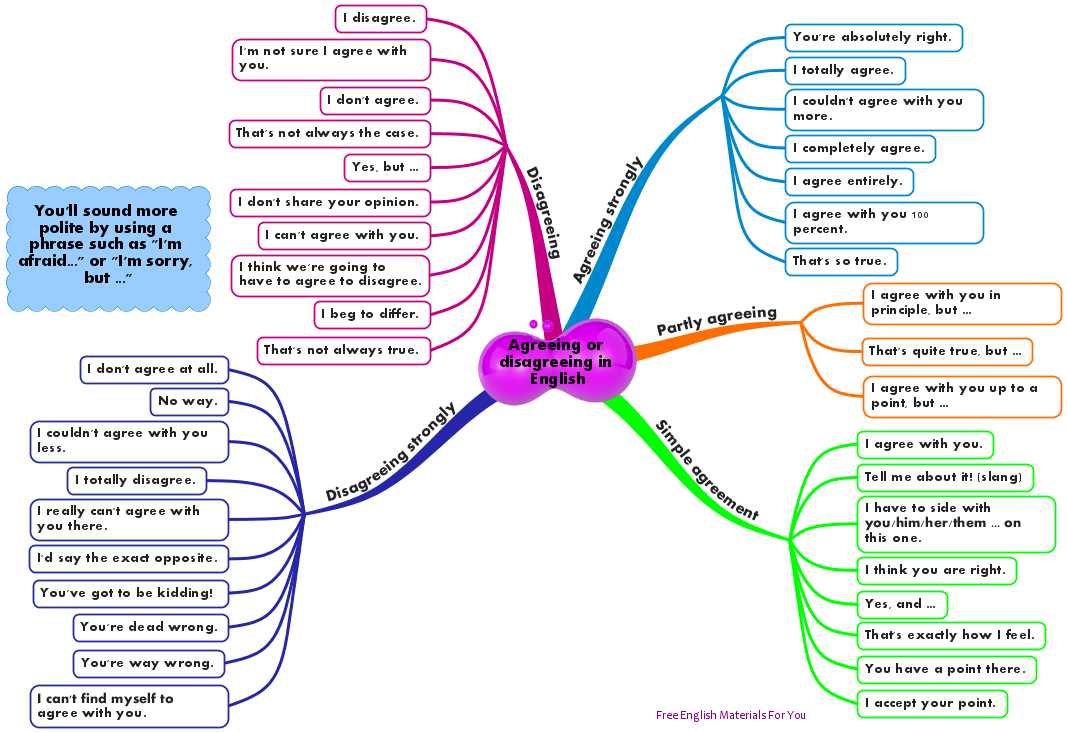
AGREEING OR DISAGREEING IN ENGLISH
Simple agreement:
Partly agreeing
Agreeing strongly
Disagreeing
Disagreeing strongly
You’ll sound more polite by using a phrase such as “I’m afraid …” or “I’m sorry but …” before disagreeing or disagreeing strongly.
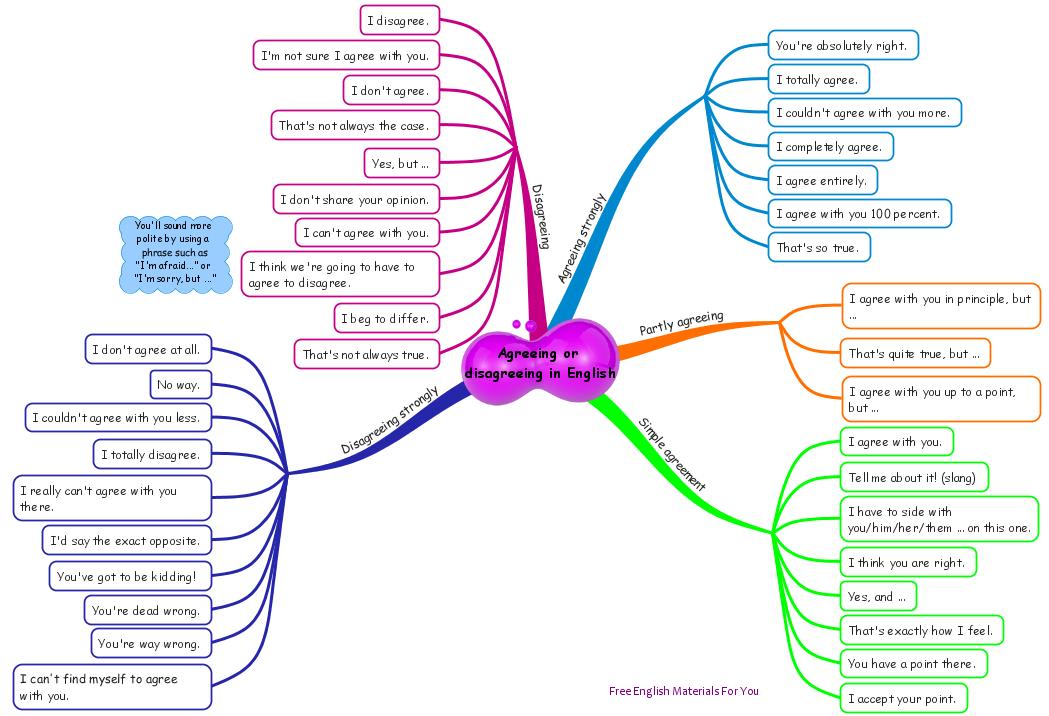
Here you can download the imx file: http://www.biggerplate.com/mindmaps/IppMHyeP/agreeing-or-disagreeing-in-english
A blog full of tips, inspiration and freebies!
Just another WordPress.com site
English-Language Thoughts
Movie Reviews, Trailers, Polls, Lists, and More!!!
 Free English Materials For You