The warring countries refused to create any official cease-fire, but on Christmas, the soldiers in the trenches declared their own unofficial truce. Source: Christmas Truce of 1914
This is a listening activity based on the AJ+ video “The Story Behind Your Bowl Of Ramen Noodles”. I suggest that you read the following vocabulary list before watching the video. Then, watch the video and try to complete the sentences with the correct word from the box.
VOCABULARY
Bowl:
Migrant: a person who goes from one place to another especially to find work.
Ex. Economic migrants move abroad to escape poverty and improve their financial condition.
Labor: workers considered as a group.
Ex. We had this huge harvest, so we had to hire all this cheap labor.
Shortage: a state in which there is not enough of something that is needed. Ex. In many European countries, agricultural businesses complain about the shortageof skilled workers.
Wheat:
Consumption: the act of eating or drinking something. Ex. Alcohol consumption constitutes a major danger to road safety.
Uprising: an act of resistance or rebellion; a revolt. Ex. He weighed 38 kilos when he escaped from prison during the 1956 Hungarian uprisingand fled to the Netherlands.
To lead: to lie or go in a specified direction. Ex. This way will leadus to the main entrance for sure.
Affordable: inexpensive; reasonably priced. Ex. Railways have many benefits, as travelling by rail is affordable and environmentally friendly.
Lifestyle: the way a person lives or a group of people live. Ex. Technology, the internet, they have changed ourlifestyle.
Quintessential: the most important part of something. Ex. Sheep’s milk cheese is the quintessentialCorsican cheese.
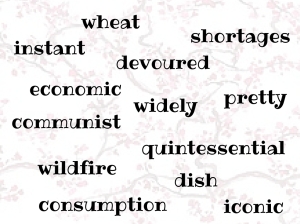
Fill in the gaps in the following sentences with the correct word from the box
This signature Japanese ___________ is now an international favorite.
Ramen as we know it comes from Japan but its popularity in the country is actually___________ new.
Then Japan entered World War II which led to major food ___________ across the country and ramen’s popularity pretty much disappeared.
When the war ended the US occupied Japan and imported a whole lot of wheat to the country, leading to more noodle _____________________.
And one reason why there was so much ______________ imported was because there was a fear that food shortages could lead to _________________uprising.
After those really hard times, from the 1950s to 1970s Japan went through an _____________________ boom.
And busy lifestyles led to the creation ________________ ramen in the 1950s.
Then in the 1970s the super convenient just add water ________________ dorm food cup of noodles was made and it took off like ________________ in Japan and internationally.
But it wasn’t until the 1980s that ramen actually became an_______________ part of Japanese culture.
Today the love for ramen is real in Japan and what was once a working men’s food is now a ___________________ love and __________________ dish around the world.
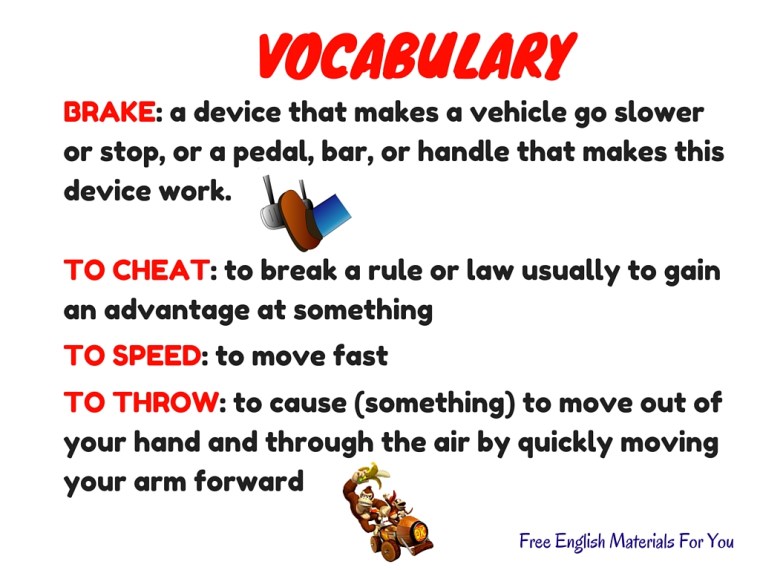
The 6th episode of English4Gamers is out :-)! In this episode, we play Super Mario Kart, a racing game for the Super Nintendo Entertainment System and the first game of the Mario Kart series. I suggest that you read the vocabulary list before watching the episode ;-). I’ll upload an interactive quiz based on this episode tomorrow or Sunday. We are trying to improve, so if you have any suggestion, please, let us know :-).
Wealthy: having a lot of money and possessions. Ex. The fisheries sector may experience temporary crises even in some relatively wealthy countries.
To struggle: to experience difficulty and make a very great effort in order to do something. Ex. The police report even said that she struggled with her assailant and broke a few fingernails.
To afford: to be able to buy or do something because you have enough money or time. Ex. Tom told me that he couldn’t afford another divorce.
Deprivation:a situation in which you do not have things or conditions that are usually considered necessary for a pleasant life. Ex. She is studying the effects of sleepdeprivation.
To feed: to give food to. Ex. I usually feed the neighbour’scatwhile she’s away.
Malnourished: not eating enough food or not eating enough healthy food. Ex. Malnourished children experience developmental delays, weight-loss and illness as a result of inadequate intake of protein, calories, and other nutrients.
Fossil fuel: any combustible organic material, as oil, coal, or natural gas, derived from the remains of former life. Ex. Brown coal is the only source of fossil fuel available in Slovenia.
Blemished: to make (something) imperfect or less beautiful; to hurt or damage the good condition of (something). Ex. The book is blemished by those long, ineffective descriptions.
Supplier: a company, person, etc. that provides things that people want or need, especially over a long period of time. Ex. Electricity customers should be able to choose their supplier freely.
To dump: to throw away or discard (garbage, etc.). Ex. The company dumped the toxic wastes into this canal.
To overflow: to flow over the edge or top of (something). Ex. The river overflowed its banks.
Complicit: involved with others in reprehensible or illegal activity. Ex. She wasaccusedof being complicitinher husband’sdeath.
To use up: to finish a supply of something. Ex. I’m sorry, I’ve used up all the milk.
Dumpster: a large metal container into which people put unwanted objects or building or garden waste, and which is brought to and taken away from a place by a special truck when people ask for it. Ex. I found your dad’s toolbox in the dumpster out back.
To toss: to throw, esp. lightly or carelessly. Ex. She came in and tossed her coat on the chair.
Retailer: a person or business that sells things directly to customers for their own use. Ex. The company is a leading retailer of women’s clothing.
Livestock:the horses, cattle, sheep, and other useful animals kept or raised on a farm or ranch. Ex. This is a market where livestock is bought and sold.
Subsidy: money that is paid usually by a government to keep the price of a product or service low or to help a business or organization to continue to function. Ex. The planned subsidy is EUR 3.3 million.
Even in the _____________nations millions suffer from food poverty.
One in four Americans says they _________________to afford food.
Over _________________ of America’s food or a hundred and sixty billion dollars worth get _________________ just by grocery stores and their customers.
Growing food demands land, water, ________________, and soil.
The tragedy is that some farmers can’t sell half of what they’ve____________ due to cosmetic standards dictated by supermarkets.
Supermarkets purposefully create an image of
[…] meanwhile, over cautious date labels confused and frightened ______________ so they out what is still good to eat.
From _____________to 2002, the average pizza slice grew 70% in calories and the average chocolate chip cookie quadrupled.
Food donations from and restaurants are proven ways of redistributing some of this nutritious surplus while is still fit for.
Instead of ________________ this food, supermarkets manufactures and caters must be pushed to directed charities that _____________ hungry people.
Governments should use the vast ______________ they offer to incentivize to look after the land in ways that protect the planet.
clipped wing generation noun the generation of young adults who are unable to be independent of their parents because they cannot afford independent living costs, William Wragg, aged 28, is among …













 Free English Materials For You