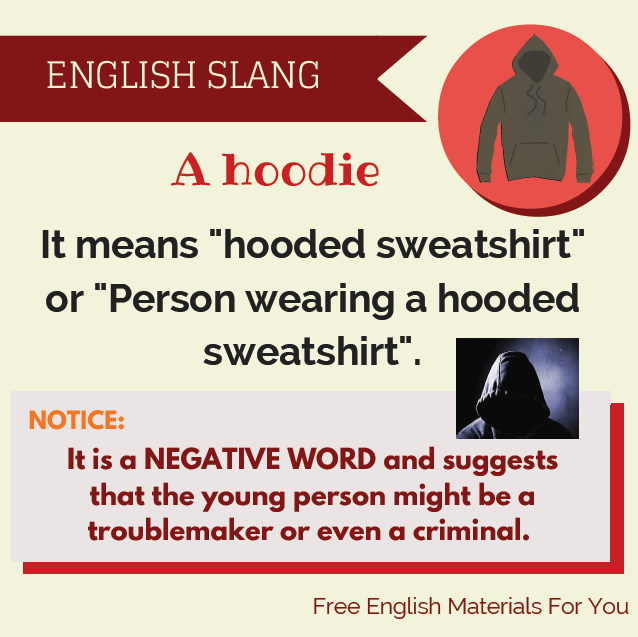
“A hoodie” – English slang

a_hoodie

A “hoodie” is also any person that lives or came from the hood (the ghetto).

Example sentences from the web:

  • There was a hoodie watching us. 
  • I just keep seeing that faceless person in the black hoodie.
  • Yall seen dem hoodies shooting dice in da cut back there?? F*ck, I think we back in da ghetto yall…
  • Don’t go near that hoodie, he’ll blow your kneecaps off.
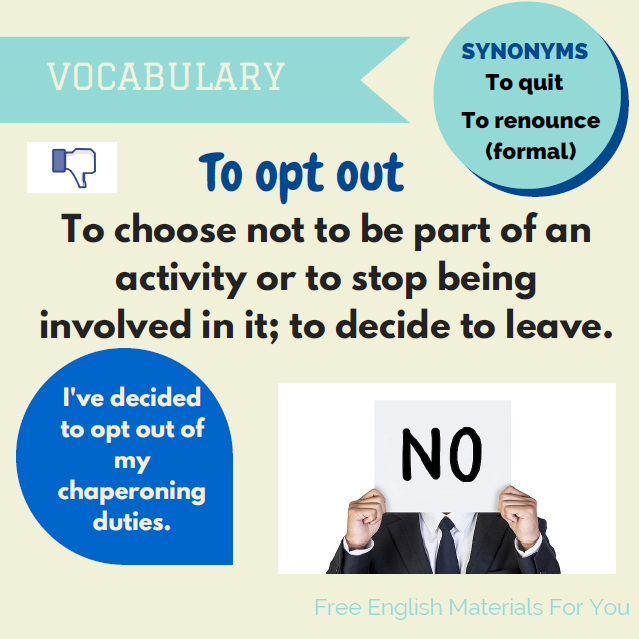
“To opt out” – What does it mean?

To_opt_out

Example sentences from the web:

  • Passengers shall be entitled to opt out from a security scanner.
  • Like every other country, since the Treaty of Amsterdam Denmark is entitled to opt out of any matters relating to military initiatives.
  • Jane decided to opt out of the project.
  • Just, from now on, if we make any changes, we have to let people opt in rather than forcing them to opt out.

Words you may not know:

CHAPERONING => to attend or acting as a chaperon.
CHAPERON => any adult present in order to maintain order or propriety at an activity of young people, as at a school dance.

TO ENTITLE => to give a right to (someone).

Ways of saying “goodbye” in English

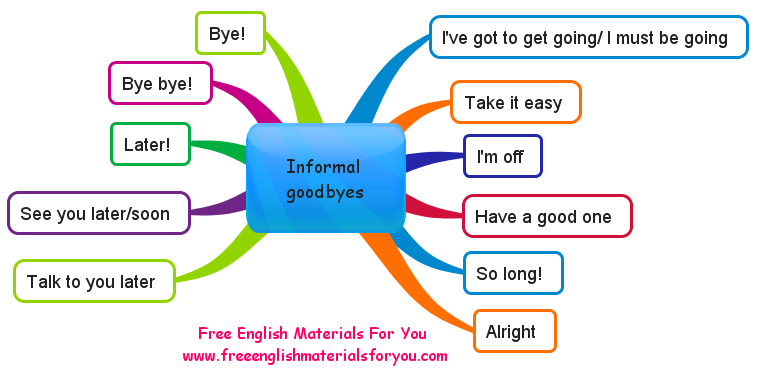
Informal_goodbyes

INFORMAL GOODBYES

  • Bye! => very common way to say goodbye.
  • Bye bye! => it sounds very kiddish (more for kids).
  • Later! => Very friendly and casual way, more for men. Ex. “Later bro!”, “Later man”.
  • See you later / soon => Very casual and relaxed goodbye. It can be used to indicate that you want to or plan to meet with the person again soon. If you use “ya” instead of “you”, this become even more casual.
  • Talk to you later
  • I’ve got to get going / I must be going => This is used in casual situations when you want to escape the conversation quickly and you don’t want to go through a longer or more sentimental goodbye.
  • Take it easy => It’s now less used than in the past. It is casual and it means “take care”.
  • I’m off
  • Have a good one => Similar to “have a nice / good day”, but it sounds really casual.
  • So long! => It’s used in some news headlines, but not so common between people.
  • Alright => Very casual way.

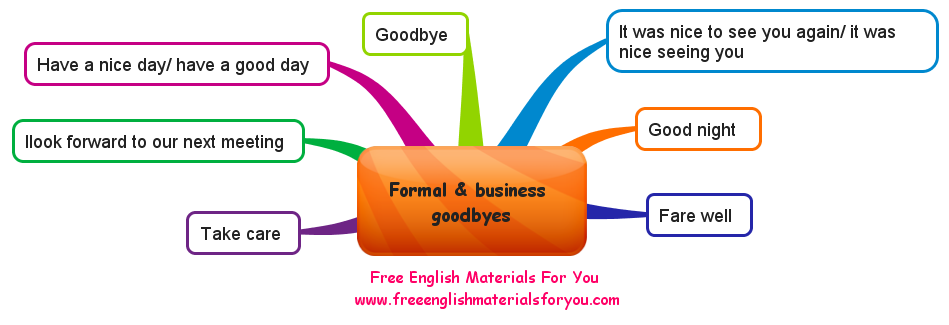
Formal_and_business_goodbyes

FORMAL AND BUSINESS GOODBYES

  • Goodbye!
  • Have a nice day / have a good day! => For example, you buy something in a shop after you have paid the cashier would tell you “Have a nice day”.
  • I look forward to our next meeting
  • Take care! => it is a little formal and you use it with your close relatives and other people you are close too. You might use this in an email or written letter.
  • It was nice to see you again / It was nice seeing you.
  • Good night!  => Notice that “good afternoon”, “good morning” and “good evening” are greeting expressions and you can’t use them to say “goodbye”).
  • Farewell => it is more like a final goodbye. For example, someone is moving abroad and you are not going to see this person again. In this situation, you can use “farewell”.  It is the type of thing that two lovers in a movie might say if they’re never going to see each other again. So, you probably won’t use it often in daily life.

Slang_ways_of_saying_goodbye

SLANG WAYS OF SAYING “GOODBYE”

  • Later / laters / catch you later
  • Peace / peace out => it comes from the hip-hop music culture. It’s more of a hand gesture. It is a very casual way and it means that you wish the other person well.
  • I’m out / I’m out of here => You are really happy about going.
  • I gotta jet / I gotta take off / I gotta hit the road / I gotta head out => these are slang versions of “I have got to get going”. “Gotta” is an abbreviation of “got to”.
  • Catch ya later! => Variation for “See you later”. This is used very casually between friends or acquaintances.
  • Smell you later! => This is something you’ll hear kids say far more than adults! But grown-ups might occasionally be overheard saying this to a friend as a joke too. 

This is a video on this topic:

Mind maps download (imx file) available on Biggerplate.

Do you know the difference between “in time” and “on time”?

On_time_vs_in_timeExample sentences from the web:

  • ON TIME
    Today’s flight is on time. Departure is 10:30 am. (=the flight will leave on time, it’s on schedule to leave at 10:30 am)
    – Remember to be on time for work tomorrow or I will fire you! (=do not be late)
    – He starts a new job at the railway station tomorrow and he wants to be on time for work.
    (= he doesn’t want to be late)
  • IN TIME
    Will you be home in time for lunch? (= soon enough for lunch)
    – He was just in time for the last train. (= he was almost too late)
    – The plot to assassinate the president was discovered just in time
    (= they could find the hit man before it was too late, otherwise, the president would have been murdered)

Video on this topic:

Now you are ready to test your knowledge on this topic :-).

//

“Out of the blue” – English idiom

Out_of_the_blue

Example sentences from the web:

  • My cousin turned up out of the blue on Christmas Day.
  • My sister Mary appeared on my doorstep out of the blue, after years with no word from her.
  • You turn up out of the blue, begging for my help in something completely illegal!
  • Stephanie called me out of the blue yesterday morning.
  • He just broke up with me out of the blue, and I have no idea why. 

Words you may not know:

TO TURN UP (past simple: “turned up”)=> to appear or come to light unexpectedly or after being lost.
TO BEG (gerund: begging) => to ask someone to give or do something; to implore.

“To cope with something/somebody” – What does it mean?

To_cope_withExample sentences from the web:

  • The car industry cannot cope with the regulations that we have enforced.
  • How can the unemployed cope with the astronomical cost of electricity?
  • To help Slovakia in coping with this demanding task, the European Union promised to provide adequate financial assistance.

Words you may not know:
REGULATION => an official rule or law that says how something should be done.
UNEMPLOYED => not employed; without a job; out of work.
ADEQUATE => enough for some need or requirement.

“It’s a piece of cake” – English Idiom

It's_a_piece_of_cake_001

Example sentences from the web:

  • I thought it was gonna be a piece of cake coming back here, but this is hard.
  • It should not be too painful for the Member States to meet each other half way under these circumstances; on the contrary it should be a piece of cake.
  • Climbing that mountain was a piece of cake.
  • With your experience, it should be a piece of cake.

Old bones are found – News in levels (level 3)

Click here for the written version, or if you want to change the level: Old bones are found.

DIFFICULT WORDS:

CRYPT => An underground room for burying people.
TO STUMBLE => To find something by chance.
SCATTER => Things that are placed randomly over an area.
TEMPLE => A building for religious practice.
DISTURBANCE => A situation when people behave violently.
DISTINCT => Special; different in a way that you can see, hear, smell, feel, etc.
DESECRATION => The act of desecrating something or treating a place with violent disrespect.
MURAL => A painting on a wall.
NATIVITY SCENE => A model which represents the birth of Jesus Christ.

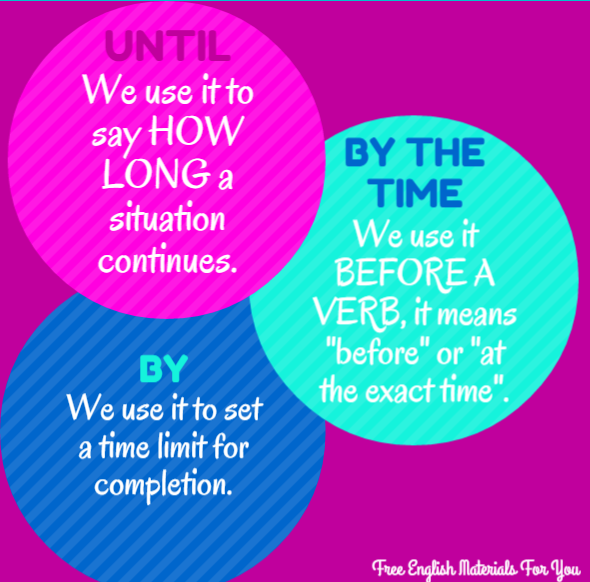
UNTIL, BY, or BY THE TIME? What’s the difference?

UNTIL._BY,_BY_THE_TIME

A video made by EngVid about this topic (for intermediate students):

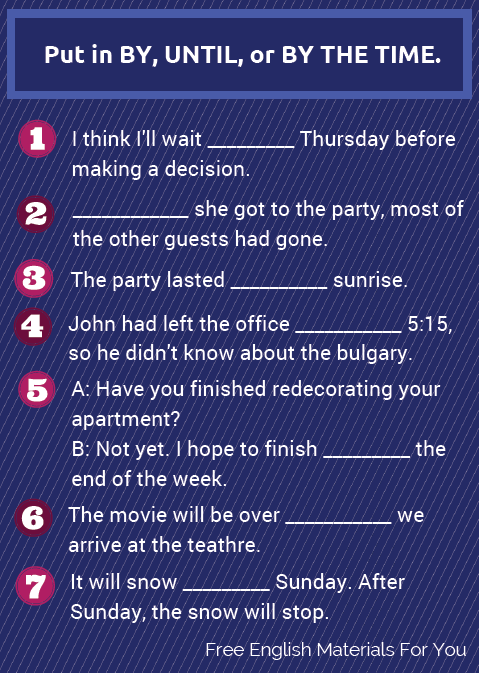
If you think you master this topic try to fill in the gaps in these sentences:

qUIZ_8-05Tomorrow the answers will be available on Facebook https://www.facebook.com/pages/Free-English-materials/887420337968020 . (Album Quizzes’ answers)