The bedroom – Visual vocabulary

635694418693689547

Watch the videos for more terms related to the bedroom and to hear how to pronounce them if you have doubts.
This one is for beginners:

For intermediate and advanced English learners:

Notice that:

  • Dresser = chest of drawers
  • Night table = bedside table

“Willingness” – What does it mean?

Willingness_-_vocabulary

Examples from the web:

  • The European Union has demonstrated its willingness to seize this opportunity.
  • I do not see any willingness among a large part of the Council to make any progress.
  • He has shown a willingness to negotiate.

Words you may not know:

TO SEIZE (something) => To take possession of something; to grasp something with the mind.

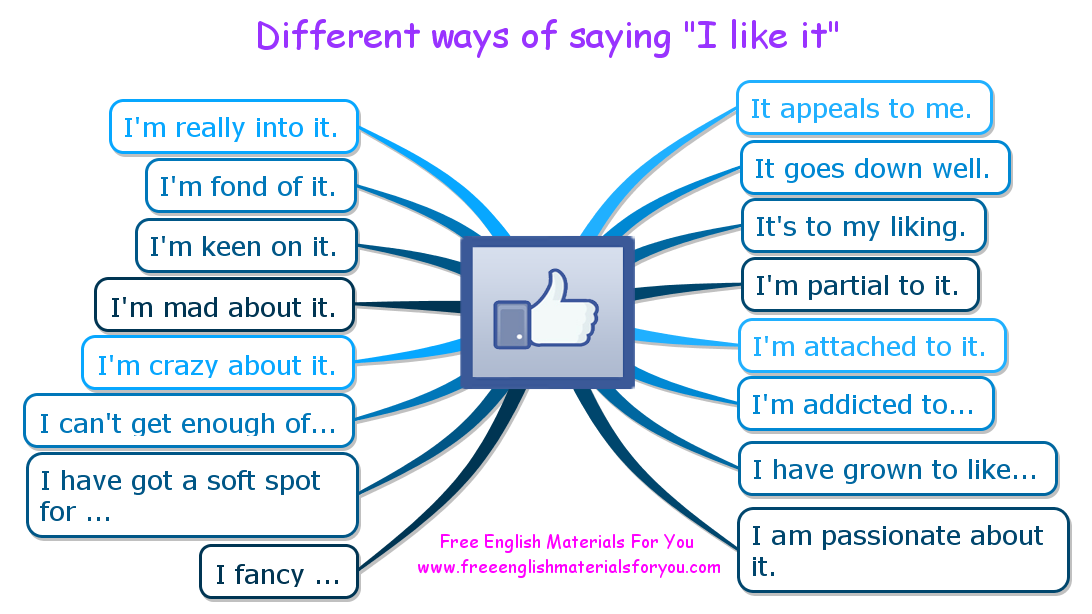
Different ways of saying “I like it”

  • Different_ways_of_saying__I_like_it_I’m really into it.
    This means you’re interested in an activity or a subject.
    Ex. I’m really into gardening, but these squirrels keep messing with my tomatoes.
  • I’m fond of it.
    This means you have liked something for a long time or may have an emotional attachment with something.
    Ex. He is fond of this kind of music.
  • I’m keen on it.
    This just means that you’re interested in something and you want to learn more about it.
    Ex. I’m keen on learning English.
  • I’m mad about it.
    I love doing something and I do it a lot.
    Ex. It’s a real tragedy, I love this woman, I’m mad about her.
  • I’m crazy about it.
    This is the same as “I’m mad about it”.
    Ex. Finnish women are crazy about cars.
  • I can’t get enough of …
    This means that I love doing it and I don’t want to stop.
    Ex. Yeah, I can’t get enough of new wave.
  • I have got a soft spot for …
    You like someone a little more than other people.
    Ex. No, don’t tell me you’ve got a soft spot for this guy.
  • I fancy him/her
    You think that he/she is attractive, good looking.
    Ex. I mean, she may fancy him, but she’d never act on it.
  • It appeals to me.
    It sounds/ looks great. I like the idea of it.
    Ex. In his report, Mr Szejna has opted for a wide approach, which appeals to me.
  • It goes down well. (With people)
    This means that other people like something that you do.
    Ex. The presentation went down really well with the class.
  • It’s to my liking.
    A very formal way to sai “I like it”.
    Ex. The colour of the paint is just to my liking!
  • I’m partial to it.
    It means that I like to eat or drink something, maybe too much.
    Ex. I like all the food here, but I’m particularly partial to the fried chicken.
  • I’m attached to it/you/him/her/them.
    I like it a lot, and if I lost it, I would be sad.
    Ex. Giovanna, I admit that I’m very attached to you.
  • I’m addicted to …
    It means that I like it so much that I can’t stop doing it.
    She looks nice enough, but she lies on her taxes and she’s addicted to painkillers.
  • I have grown to like …
    I didn’t like it at first, but now I do.
    Ex. I’ve grown to like the music of Radiohead.
  • I am passionate about it.
    This means I’m really interested and excited about it.
    Ex. Julia runs the selection committee, and she’s very passionate about the candidates.

You can download this mind map on Biggerplate.

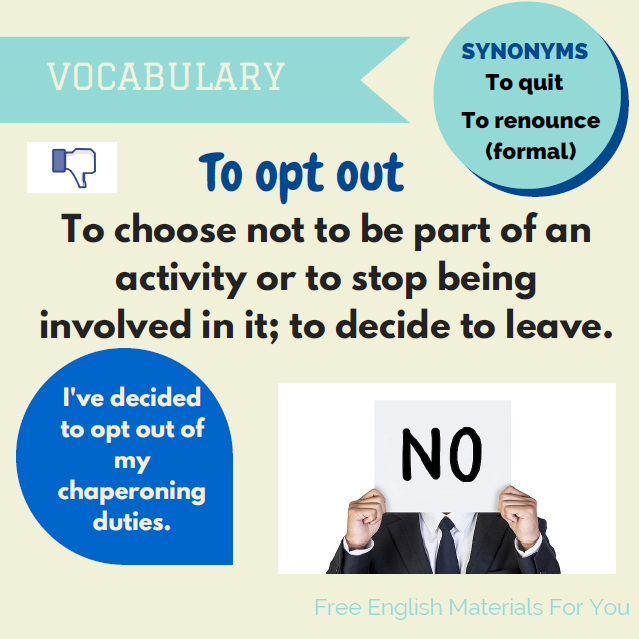
“To opt out” – What does it mean?

To_opt_out

Example sentences from the web:

  • Passengers shall be entitled to opt out from a security scanner.
  • Like every other country, since the Treaty of Amsterdam Denmark is entitled to opt out of any matters relating to military initiatives.
  • Jane decided to opt out of the project.
  • Just, from now on, if we make any changes, we have to let people opt in rather than forcing them to opt out.

Words you may not know:

CHAPERONING => to attend or acting as a chaperon.
CHAPERON => any adult present in order to maintain order or propriety at an activity of young people, as at a school dance.

TO ENTITLE => to give a right to (someone).

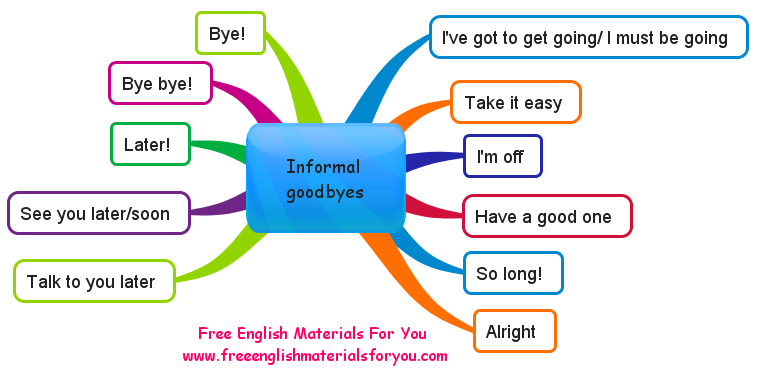
Ways of saying “goodbye” in English

Informal_goodbyes

INFORMAL GOODBYES

  • Bye! => very common way to say goodbye.
  • Bye bye! => it sounds very kiddish (more for kids).
  • Later! => Very friendly and casual way, more for men. Ex. “Later bro!”, “Later man”.
  • See you later / soon => Very casual and relaxed goodbye. It can be used to indicate that you want to or plan to meet with the person again soon. If you use “ya” instead of “you”, this become even more casual.
  • Talk to you later
  • I’ve got to get going / I must be going => This is used in casual situations when you want to escape the conversation quickly and you don’t want to go through a longer or more sentimental goodbye.
  • Take it easy => It’s now less used than in the past. It is casual and it means “take care”.
  • I’m off
  • Have a good one => Similar to “have a nice / good day”, but it sounds really casual.
  • So long! => It’s used in some news headlines, but not so common between people.
  • Alright => Very casual way.

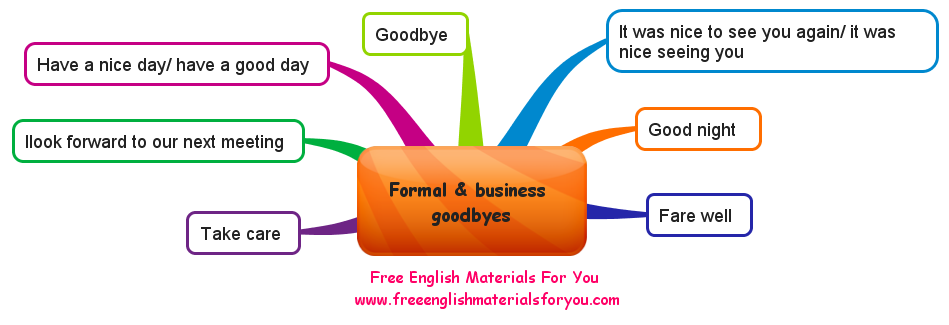
Formal_and_business_goodbyes

FORMAL AND BUSINESS GOODBYES

  • Goodbye!
  • Have a nice day / have a good day! => For example, you buy something in a shop after you have paid the cashier would tell you “Have a nice day”.
  • I look forward to our next meeting
  • Take care! => it is a little formal and you use it with your close relatives and other people you are close too. You might use this in an email or written letter.
  • It was nice to see you again / It was nice seeing you.
  • Good night!  => Notice that “good afternoon”, “good morning” and “good evening” are greeting expressions and you can’t use them to say “goodbye”).
  • Farewell => it is more like a final goodbye. For example, someone is moving abroad and you are not going to see this person again. In this situation, you can use “farewell”.  It is the type of thing that two lovers in a movie might say if they’re never going to see each other again. So, you probably won’t use it often in daily life.

Slang_ways_of_saying_goodbye

SLANG WAYS OF SAYING “GOODBYE”

  • Later / laters / catch you later
  • Peace / peace out => it comes from the hip-hop music culture. It’s more of a hand gesture. It is a very casual way and it means that you wish the other person well.
  • I’m out / I’m out of here => You are really happy about going.
  • I gotta jet / I gotta take off / I gotta hit the road / I gotta head out => these are slang versions of “I have got to get going”. “Gotta” is an abbreviation of “got to”.
  • Catch ya later! => Variation for “See you later”. This is used very casually between friends or acquaintances.
  • Smell you later! => This is something you’ll hear kids say far more than adults! But grown-ups might occasionally be overheard saying this to a friend as a joke too. 

This is a video on this topic:

Mind maps download (imx file) available on Biggerplate.

“To cope with something/somebody” – What does it mean?

To_cope_withExample sentences from the web:

  • The car industry cannot cope with the regulations that we have enforced.
  • How can the unemployed cope with the astronomical cost of electricity?
  • To help Slovakia in coping with this demanding task, the European Union promised to provide adequate financial assistance.

Words you may not know:
REGULATION => an official rule or law that says how something should be done.
UNEMPLOYED => not employed; without a job; out of work.
ADEQUATE => enough for some need or requirement.

Test (Intermediate-level English students)

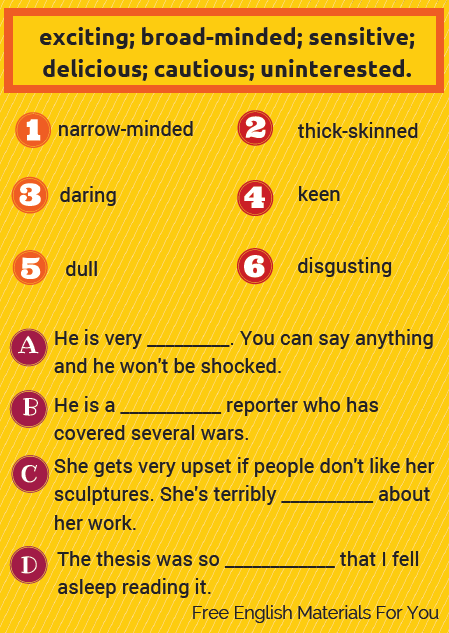
Match the adjectives in the box with their opposites. Then complete the sentences A) =>D) with one of the adjectives of the first part of the test.
test_13-05

Tomorrow the answers will be available on Facebook: Free English Materials (Album Quizzes’ answers)

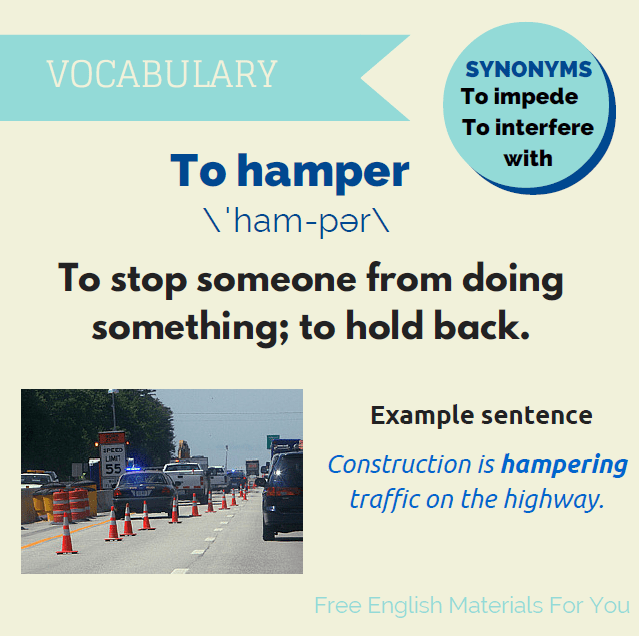
“To hamper” – What does it mean?

To_hamperOther examples from the web:

  • Fog hampered the rescue effort.
  • The dancers’ movements were hampered by their elaborate costumes.
  • Unlike Mrs Andreasen, I do not think that this transparency will hamper the finance industry’s competitiveness.
  • There are really too many obstacles hampering citizens wishing to study, work or go and shop in another Member State.

Words from the example sentences you may not know:

RESCUEthe act of rescuing; to free or deliver from confinement, violence, danger, or evil.
ELABORATE = made or done with great care or with much detail.