“A friend in need is a friend indeed”. – English proverb

A_friend_in_need_is_a_friend_indeed.

Example sentences from the web:

  • When I was sick you certainly proved the old saying, “A friend in need is a friend indeed“.
  • When Bill helped me with geometry, I really learned the meaning of “A friend in need is a friend indeed”.

“To cope with something/somebody” – What does it mean?

To_cope_withExample sentences from the web:

  • The car industry cannot cope with the regulations that we have enforced.
  • How can the unemployed cope with the astronomical cost of electricity?
  • To help Slovakia in coping with this demanding task, the European Union promised to provide adequate financial assistance.

Words you may not know:
REGULATION => an official rule or law that says how something should be done.
UNEMPLOYED => not employed; without a job; out of work.
ADEQUATE => enough for some need or requirement.
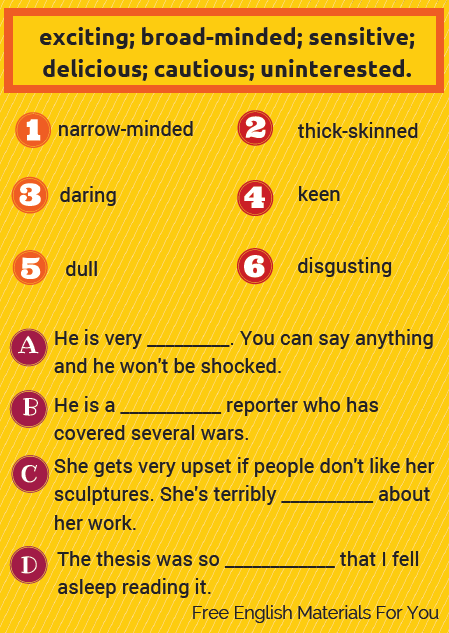
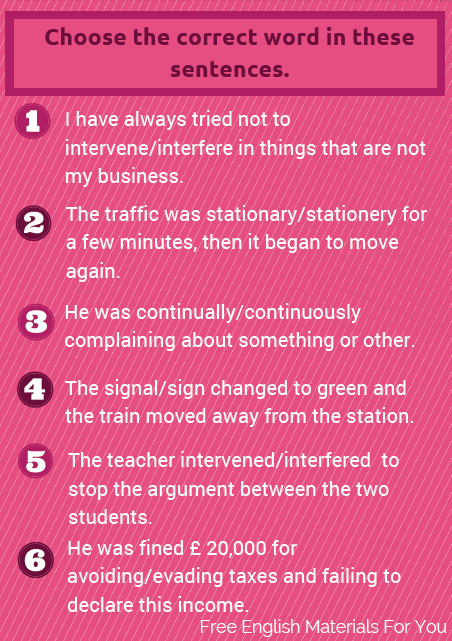
Test (Intermediate-level English students)

Match the adjectives in the box with their opposites. Then complete the sentences A) =>D) with one of the adjectives of the first part of the test.
test_13-05

Tomorrow the answers will be available on Facebook: Free English Materials (Album Quizzes’ answers)

“It’s a piece of cake” – English Idiom

It's_a_piece_of_cake_001

Example sentences from the web:

  • I thought it was gonna be a piece of cake coming back here, but this is hard.
  • It should not be too painful for the Member States to meet each other half way under these circumstances; on the contrary it should be a piece of cake.
  • Climbing that mountain was a piece of cake.
  • With your experience, it should be a piece of cake.

Old bones are found – News in levels (level 3)

Click here for the written version, or if you want to change the level: Old bones are found.

DIFFICULT WORDS:

CRYPT => An underground room for burying people.
TO STUMBLE => To find something by chance.
SCATTER => Things that are placed randomly over an area.
TEMPLE => A building for religious practice.
DISTURBANCE => A situation when people behave violently.
DISTINCT => Special; different in a way that you can see, hear, smell, feel, etc.
DESECRATION => The act of desecrating something or treating a place with violent disrespect.
MURAL => A painting on a wall.
NATIVITY SCENE => A model which represents the birth of Jesus Christ.

To go – Phrasal verbs

go_pv_mind_map

You can download this mind map (imx. file) on Biggerplate.

EXAMPLE SENTENCES FROM THE WEB:

  • GO FOR
    1) To be attracted to; to have an interest in.
    You and me … We go for the bad boys.
    – He tends to go for girls like her.
    2) To attack.
     The neighbour’s dog went for the postman and bit him.
    – He is known to go for the jugular in arguments.
    3) To seek to obtain; to choose.
    – I think they would go for that kind of centralization.
    – I could really go for some hot wings.
  • GO THROUGH
    1) To bear; to experience a difficult/unpleasant situation.
    – Nobody would want to go through something like that.
    – In Malta, my fellow workers are going through disastrous changes.
    2) To examine the contents of something carefully.
    – We need to go through every message and assess the damage.
     That subpoena gives us the right to go through your files.
  • GO IN FOR
    1) To occupy oneself with; to engage in
    She goes in for volleyball.
    We have responded more to the will of our citizens and have been that much less inclined to go in for big events.
    – This will enable our students to go in for a three-year degree, in Italian, directly from Cairo and also take the exams in Egypt.
    2) To have or show an interest in or liking for.
    I thought you didn’t go in for those kinds of shenanigans.
    I don’t go in for those modern things.
    3) To enter a competition or to take an examination.
    My brother decided to cheer himself up by going in for a competition. The prize was a luxury holiday in the Caribbean.
    – He went in for the photography prize but didn’t win.
    – His school had suggested he go in for the Young Musician of the Year competition.
  • GO WITHOUT
    To be denied or deprived of something
    If you don’t like your tea, you can go without.
    She has had to go without a holiday for several years now.
    There were days I knew he went without food to buy music paper.
  • GO ABOUT
    1) To occupy oneself with; to perform
    – Meanwhile, the unsuspecting citizens of Coruscant go about their daily lives.
    – The shoemaker goes about his work with a smile.
    2) To begin to do
    We went about getting evidence of what was going on.
    How can I go about getting a good idea?
  • GO THROUGH WITH
    To stay with (something) to the end even if it’s something unpleasant or difficult.
    She went through with the divorce.
    We’re going to use him to go through with the transaction.
    Now you won’t have to go through with all that mess.
  • GO OFF
    1) To explode, or to make a loud noise.
    The bomb could go off at any moment.
    – The Hulk is a bomb waiting to go off.
    2) To leave suddenly.
    John went off with the money.
    Brian is going off to Milan and we’re throwing him a farewell party.
    3) To become angry quickly.
    He went off in a flash when he heard the news. I’ve never seen him so upset.
    4) To cease to be available, running, or functioning (of a light, electricity, or heating); to stop.
    The generator went off and we can’t get it started again.
    – The lights go off every six minutes, you know, to save electricity and stuff.

    5) To begin (with alarms, or signals).
    My alarm clock didn’t go off today and that’s why I was late.
    My alarm clock went off at 7:00 a.m.
    – It’s programmed to go off before you do.

    6) To follow the expected or desired course; to occur specified.
    The party went off well.
    7) To go bad; to decay.
    Something has gone off in the fridge, there’s a horrible smell.
    – The food went off very quickly, we had to throw it all.
  • GO ON
    1) To happen or take place.
    What’s going on at school?
    What’s going on outside? All your friends are out in the street carrying placards.
    2) To continue; to proceed; to keep on.
    Please, go on. Don’t let me interrupt you.
    Go on, tell me what happened next.

    3) To start running or functioning (of power, water supply, etc.)
    – The alarm goes on when you close the front door.
    4) To act or behave.
    – Don’t go on like that; stop kicking the dog.
  • GO ALONG WITH
    To agree with someone’s opinion/decision; to support an idea.
    I said it wouldn’t work. I didn’t go along with it from the beginning.
    – She’s still angry with me for going along with your idea.
  • GO TOGETHER
    1) To have a romantic relationship (informal).
    Are Mark and Mary still going together?
    They had been going together for years.
    2) To look or taste good when experienced at the same time (items of clothing, furniture or food).
    – Fish and red wine don’t go together.
    – Drinking and driving don’t go together.

I made this quiz for you :-), it will take you no more than 15 minutes. Try it out to check your knowledge about this topic.

//