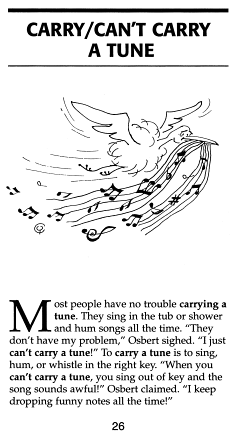
“Can’t carry a tune” – English idiom

Can't_carry_a_tune

can't_carry_a_tune_-_Fun_with_idioms

Image source

Variations of this idiom with the same meaning:

can’t carry a tune in a bucket;

can’t carry a tune in a bushel basket;

can’t carry a tune in a paper sack.

Examples from the web:

  • Mark: “Sing with us!”
    John: “Sorry. You wouldn’t want me to. I can’t carry a tune.”
  • I invited Sarah to join the choir but she refused, she told me she can’t carry a tune in a bucket.

A short article I found while surfing the web: “Can’t Carry a Tune? Work Out Your Vocal Muscles”. by Lena Groeger
This is the link (I opened it with Lingro, in this way if you click on a term that you don’t know, you can read the definition in English): http://lingro.com/translate/http://www.scientificamerican.com/article/physically-out-of-tune/
In short, the article is about physical reasons of bad singing.

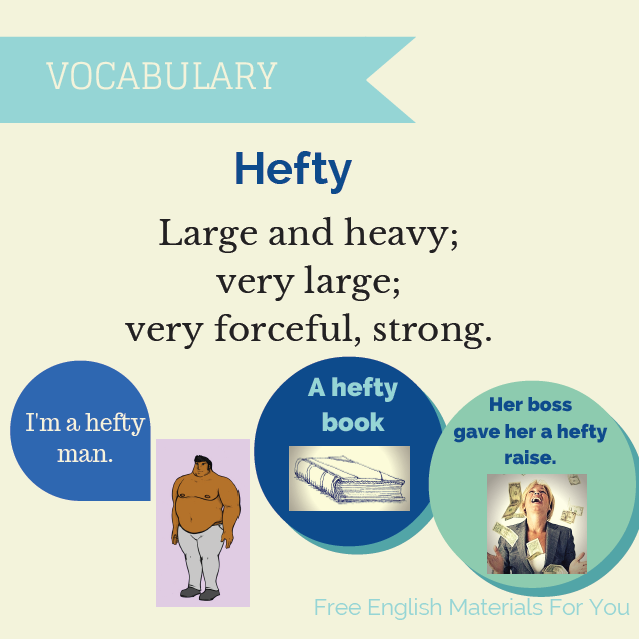
“Groundbreaking” – What does it mean?

Groundbreaking

Other examples from the web:

  • We all commended the new US vision on reaching a framework agreement as groundbreaking and forward-looking.
  • The transformation of this elementary teacher, as a result of this groundbreaking work, has occurred at both the personal and transformative levels.
  • The decisions taken at the Spring European Council for an integrated energy and climate protection policy are groundbreaking.

Words from the example sentences you may not know:

FORWARD-LOOKING = planning for the future; progressive; modern.

TO OCCUR = to happen; to take place.

TO INTEGRATE =  to combine to form/create something; unify.

We all commended the new US vision on reaching a framework agreement as groundbreaking and forward-looking.

“To boast” – What does it mean?

To_boast

Examples from the web:

  • It is a fact that countries with high taxes cannot boast of any visible success in the fight against alcoholism.
  • “I’ve sold more paintings than you ever will,” the artist boasted.
  • The city boasts a fine cathedral.
  • He boasts that he can speak six languages.
  • In comparison to other European countries, Poland can boast of significant achievements in the field of environmental protection.

TO END vs TO FINISH – Collocations in English

To_end_vs_to_finishBased on: McCarthy, M. O’Dell, F. (2008), Collocations in use, Cambridge: Cambridge University Press.

TO END

  • To stop with a clear conclusion. We use it when there’s an important change.
    Example: World War II ended in 1945.
  • END can’t be followed by either the infinitive (to- form) or the -ing form.
    Example: Mark ended drying his hair. => This sentence isn’t correct!
    The correct sentence is: Mark finished drying his hair.

TO FINISH

  • To bring something to an end.
    Example: Are you sure you’ll finish your essay by Monday?
  • To eat, drink the last of something.
    Example: I’m sorry, I just finished the coffee.
  • It can be followed by the -ing form, but not by the infinitive.
    Example: They have finished to play. => This sentence is not correct!
    The correct sentence is: They have finished playing.

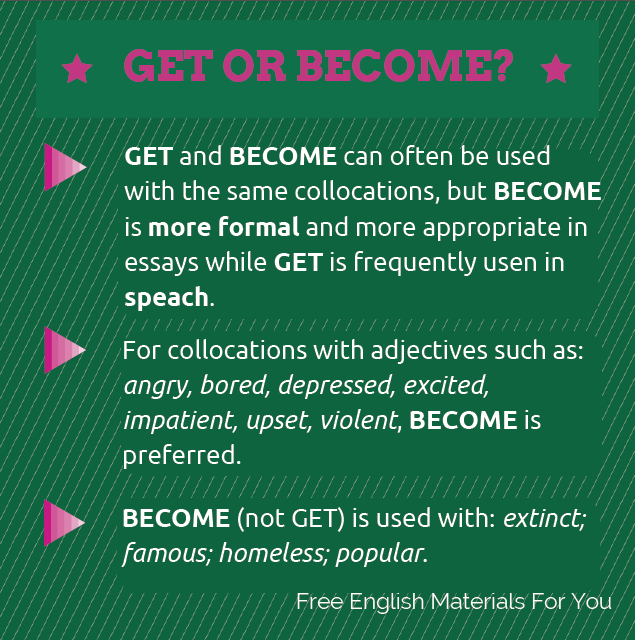
GET or BECOME?

GET_OR_BECOME_WEBSITEBased on: McCarthy, M. O’Dell, F. (2008), Collocations in use, Cambridge: Cambridge University Press.

Examples from the web:

  • got interested in comic books at the age of 14.  (Informal)
  • I became interested in linguistics after high school. (formal)
  • Disabled people are becoming angry at the lack of attention that they get.
  • Because of Tom, Mary has become depressed.
  • During the military conflict in Darfur about 200 000 people have perished, and 2.5 million of the province’s people have become homeless.
  • The tickets sold out long before the team became popular.

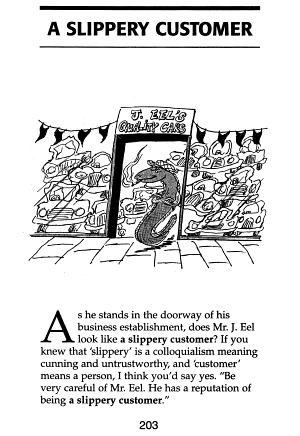
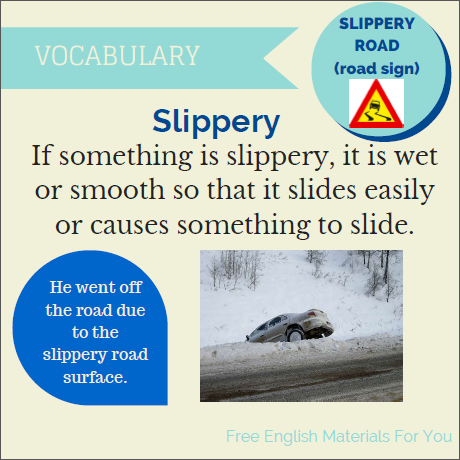
“Slippery customer” – English idiom

Slippery_customer_-_website
A_slippery_customer_-_bookImage source

Other examples from the web:

  • Watch out for that girl with the red hat and don’t believe what she says. She’s a slippery customer.
  • He’s a slippery customer, that Tim, I’ve never felt comfortable with him.

Watch out = to be careful; to remain vigilant.
To snatch = to take something or someone quickly and suddenly; to grab.
Untrustworthy = not able to be trusted.
Cunning = getting what is wanted in a clever and often deceptive way.