Do you know the difference between “to shout to somebody” and “to shout at somebody”?

Difference_between_shout_to_and_shout_at
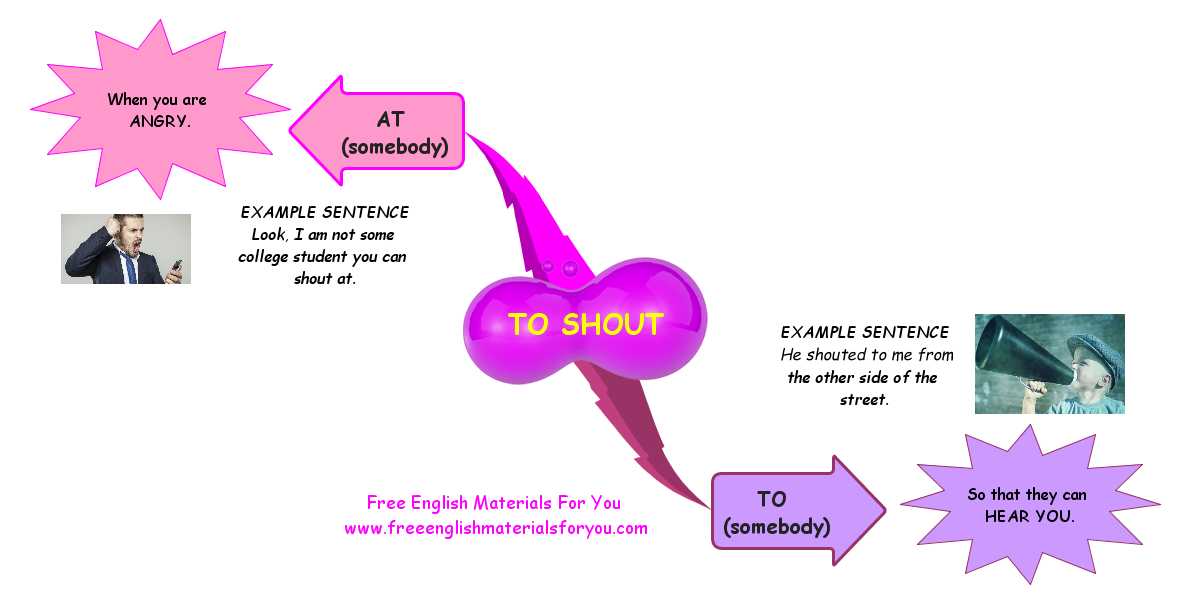
TO SHOUT AT (somebody) => When you are angry.
TO SHOUT TO (somebody) => When you want  people to hear you.

Example sentences:

  • Look, I am not some college student you can shout at.
  • He shouted to me from the other side of the street.

If you want you can download this mind map as imx file here: Biggerplate.

“The pen is mightier than the sword”. – English proverb

proverb_-_28-05

The pen is usually linked with writing while the sword is a weapon. Only who is strong can wield a sword. But words can flow from the pen of even a feeble man.
A person can cause people to change their opinions and not by force. Those who control information have far more power than those with military force.

“Willingness” – What does it mean?

Willingness_-_vocabulary

Examples from the web:

  • The European Union has demonstrated its willingness to seize this opportunity.
  • I do not see any willingness among a large part of the Council to make any progress.
  • He has shown a willingness to negotiate.

Words you may not know:

TO SEIZE (something) => To take possession of something; to grasp something with the mind.

Different ways of saying “I like it”

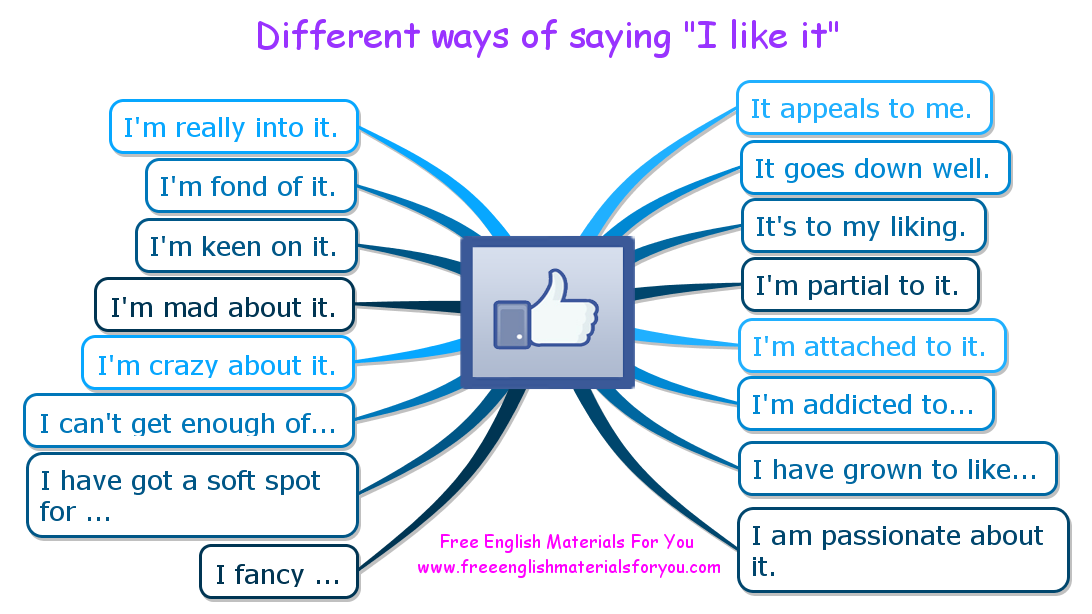
  • Different_ways_of_saying__I_like_it_I’m really into it.
    This means you’re interested in an activity or a subject.
    Ex. I’m really into gardening, but these squirrels keep messing with my tomatoes.
  • I’m fond of it.
    This means you have liked something for a long time or may have an emotional attachment with something.
    Ex. He is fond of this kind of music.
  • I’m keen on it.
    This just means that you’re interested in something and you want to learn more about it.
    Ex. I’m keen on learning English.
  • I’m mad about it.
    I love doing something and I do it a lot.
    Ex. It’s a real tragedy, I love this woman, I’m mad about her.
  • I’m crazy about it.
    This is the same as “I’m mad about it”.
    Ex. Finnish women are crazy about cars.
  • I can’t get enough of …
    This means that I love doing it and I don’t want to stop.
    Ex. Yeah, I can’t get enough of new wave.
  • I have got a soft spot for …
    You like someone a little more than other people.
    Ex. No, don’t tell me you’ve got a soft spot for this guy.
  • I fancy him/her
    You think that he/she is attractive, good looking.
    Ex. I mean, she may fancy him, but she’d never act on it.
  • It appeals to me.
    It sounds/ looks great. I like the idea of it.
    Ex. In his report, Mr Szejna has opted for a wide approach, which appeals to me.
  • It goes down well. (With people)
    This means that other people like something that you do.
    Ex. The presentation went down really well with the class.
  • It’s to my liking.
    A very formal way to sai “I like it”.
    Ex. The colour of the paint is just to my liking!
  • I’m partial to it.
    It means that I like to eat or drink something, maybe too much.
    Ex. I like all the food here, but I’m particularly partial to the fried chicken.
  • I’m attached to it/you/him/her/them.
    I like it a lot, and if I lost it, I would be sad.
    Ex. Giovanna, I admit that I’m very attached to you.
  • I’m addicted to …
    It means that I like it so much that I can’t stop doing it.
    She looks nice enough, but she lies on her taxes and she’s addicted to painkillers.
  • I have grown to like …
    I didn’t like it at first, but now I do.
    Ex. I’ve grown to like the music of Radiohead.
  • I am passionate about it.
    This means I’m really interested and excited about it.
    Ex. Julia runs the selection committee, and she’s very passionate about the candidates.

You can download this mind map on Biggerplate.

“A hoodie” – English slang

a_hoodie

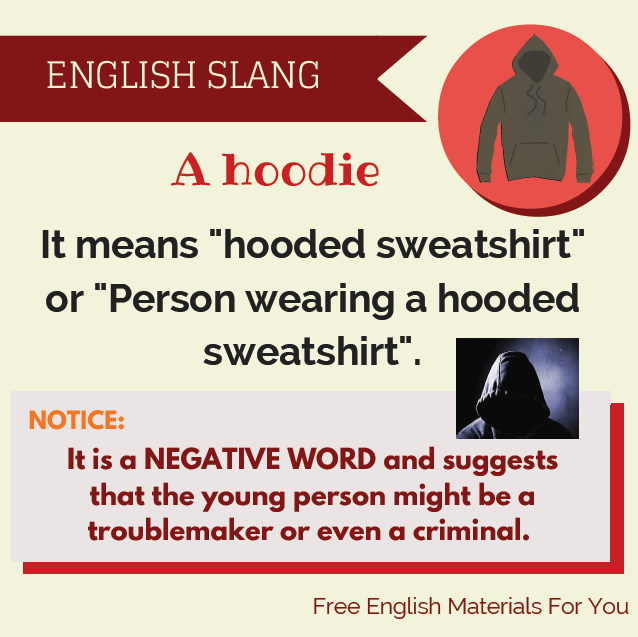
A “hoodie” is also any person that lives or came from the hood (the ghetto).

Example sentences from the web:

  • There was a hoodie watching us. 
  • I just keep seeing that faceless person in the black hoodie.
  • Yall seen dem hoodies shooting dice in da cut back there?? F*ck, I think we back in da ghetto yall…
  • Don’t go near that hoodie, he’ll blow your kneecaps off.

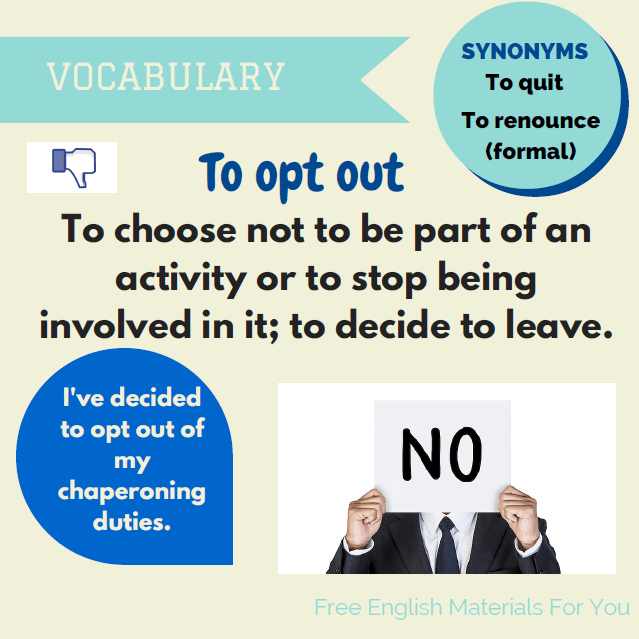
“To opt out” – What does it mean?

To_opt_out

Example sentences from the web:

  • Passengers shall be entitled to opt out from a security scanner.
  • Like every other country, since the Treaty of Amsterdam Denmark is entitled to opt out of any matters relating to military initiatives.
  • Jane decided to opt out of the project.
  • Just, from now on, if we make any changes, we have to let people opt in rather than forcing them to opt out.

Words you may not know:

CHAPERONING => to attend or acting as a chaperon.
CHAPERON => any adult present in order to maintain order or propriety at an activity of young people, as at a school dance.

TO ENTITLE => to give a right to (someone).

Do you know the difference between “in time” and “on time”?

On_time_vs_in_timeExample sentences from the web:

  • ON TIME
    Today’s flight is on time. Departure is 10:30 am. (=the flight will leave on time, it’s on schedule to leave at 10:30 am)
    – Remember to be on time for work tomorrow or I will fire you! (=do not be late)
    – He starts a new job at the railway station tomorrow and he wants to be on time for work.
    (= he doesn’t want to be late)
  • IN TIME
    Will you be home in time for lunch? (= soon enough for lunch)
    – He was just in time for the last train. (= he was almost too late)
    – The plot to assassinate the president was discovered just in time
    (= they could find the hit man before it was too late, otherwise, the president would have been murdered)

Video on this topic:

Now you are ready to test your knowledge on this topic :-).

//

“Out of the blue” – English idiom

Out_of_the_blue

Example sentences from the web:

  • My cousin turned up out of the blue on Christmas Day.
  • My sister Mary appeared on my doorstep out of the blue, after years with no word from her.
  • You turn up out of the blue, begging for my help in something completely illegal!
  • Stephanie called me out of the blue yesterday morning.
  • He just broke up with me out of the blue, and I have no idea why. 

Words you may not know:

TO TURN UP (past simple: “turned up”)=> to appear or come to light unexpectedly or after being lost.
TO BEG (gerund: begging) => to ask someone to give or do something; to implore.