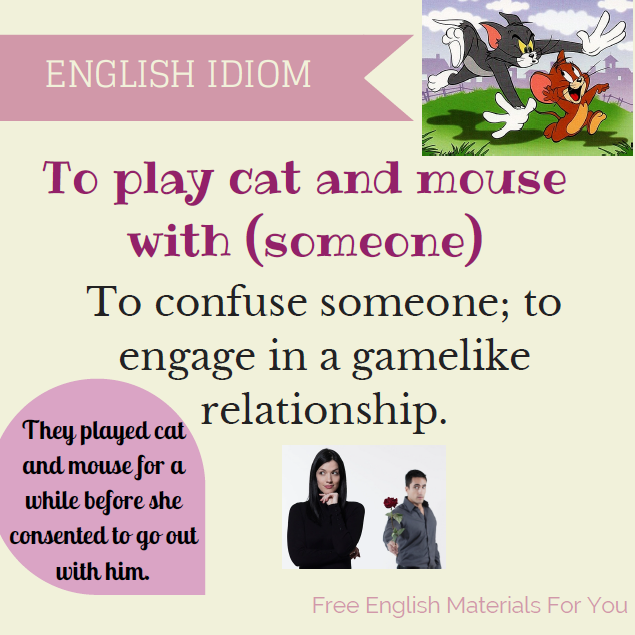
To play cat and mouse with (someone) – English idiom

To play cat and mouse withExample sentences from the web:

  • The man is playing cat and mouse with his company about his plans to quit or not.
  • She loved to play cat and mouse with an admirer, acting by turns friendly, indifferent, and jealous.
  • The actor spent all the week playing cat and mouse with the press.

Geography – Visual vocabulary

Pro Ace’s video on GEOGRAPHY – VOCABULARY:

Here more terms, for intermediate and advanced English students (video made by London English Classes):

WG4370Geographical_Features_Teaching_Classroom_Display_Poster

Image source

 Click here to play hangman games on this topic: game

How to express emotions/feelings in English – (for beginner and intermediate English students)

wheel of emotions

Image source

How to express feelings in English (for beginners) – PRO ACE’s video

How to express emotions in English (for beginners) – Shaw English Online’s video:

Expressing feelings in English (for Intermediate English students) – ESLEnglishFaby’s video:

Quiz on vocabulary – for advanced English learners

Fill in the gaps in the sentences. Use a dictionary if necessary.

Vocabulary quiz

McCarthy, M., O’Dell, F. (2006), English Vocabulary in Use, Cambridge: Cambridge University Press, p. 139.


Tomorrow the answers will be available on Facebook: Free English Materials
(Album: Quizzes’ answers).

“To be a big fish in a small pond” – English idiom

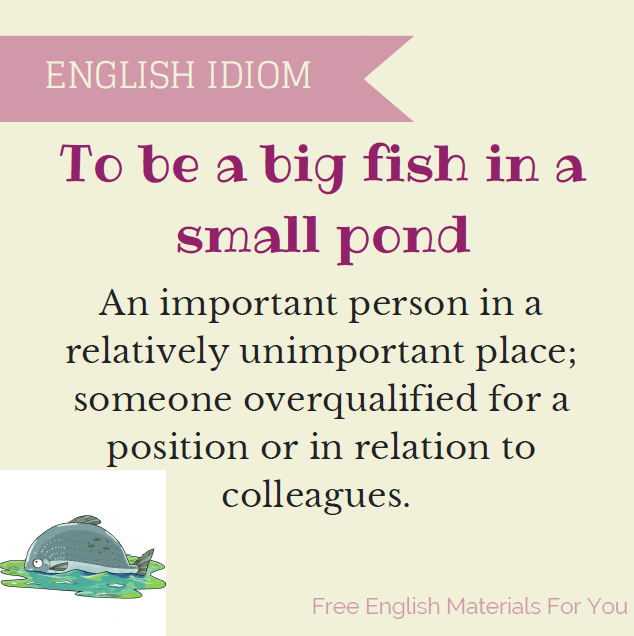
To be a big fish in a small pond

Example sentences from the web:

  • As long as you stay, you’re a big fish in a small pond… …and can blame everyone for holding you back.
  • Steve has both a Ph.D. and an M.D., yet he’s content with his practice at a rural hospital; he prefers to be a big fish in a little pond.
  • I’ve got to get out of this town. It’s just too small. I’m tired of being a big fish in a small pond. I want to move to a big city like New York or Los Angeles.

NOTICE that this idiom could be used with a different meaning, referring to someone who is important in a small group or organization, but who won’t be so important in a larger one.

  • “If he is such a great actor, why doesn’t he move to New York City?”
    Reply: “He likes being a big fish in a small pond.”

This idiom is explained very well here: http://painintheenglish.com/ 

“For example, a man started his own heating / air conditioning repair company. He had 4 locations and a fleet of 10 trucks. He was a prominent businessman in the community and his business netted $1 million per year. In a town of 25,000 people, he was in the top 1% of incomes and because he brought so much money into the community, he had a certain leverage with the city council. They would be very careful to allow building permits near his businesses without checking with him first.

However, if that man moved to a large city, for example: New York City, then 4 locations, 10 trucks, $1 million / year would not be special at all. For a small town (pond), he had a big business (he was a big fish), but in a large lake (New York City), he was a much smaller business (much smaller fish) by comparison”.

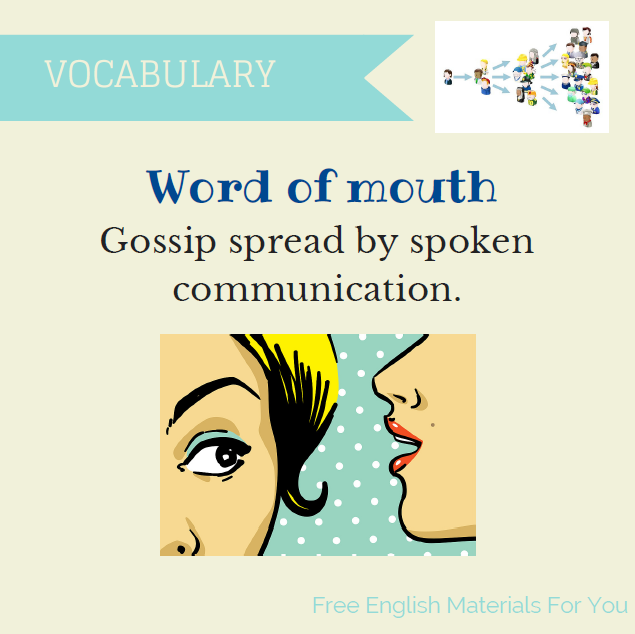
Word of mouth – What does it mean?

word of mouth

Example sentences from the web:

  • The news of their affair was spread by word of mouth.
  • Word of mouth is the best advertisement.
  • I get paid to create word of mouth about cool new products.

Words you may not know:

AFFAIR => an intense amorous relationship, usually of short duration.
TO SPREAD => to tell information to a lot of people.

“To have/get butterflies in (one’s) stomach”. – English idiom

635686682202577954

Image source

Example sentences from the web:
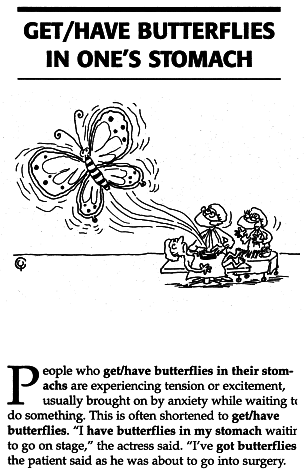
  • Her mouth was dry, there were butterflies in her stomach, and her knees were shaking so much it was hard to walk on stage.
  • The first day in front of a class, new teachers always have butterflies in their stomachs.
  • Before I went on stage, I had butterflies in my stomach.

635686667371089641

Image source