Irregular verbs

It’s since a while that I am not uploading posts on grammar. In my opinion, for a beginner is not so easy to memorize irregular verbs, that’s why I decided to make mind maps and other resources on this topic. I hope you’ll find it useful.
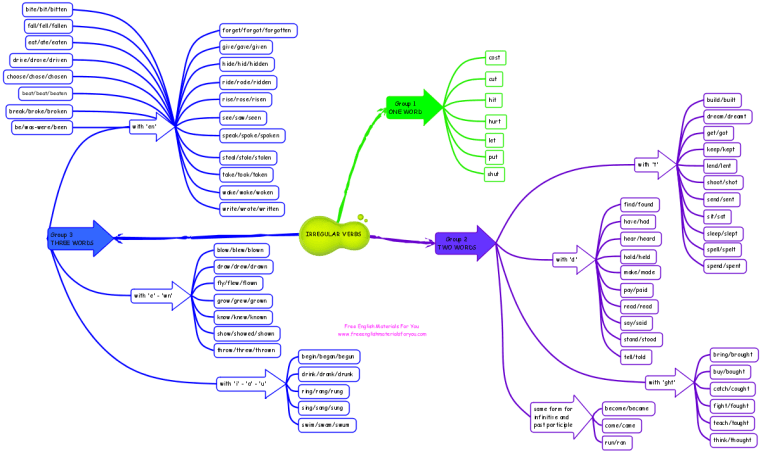
Irregular verbs in English - mind map

You can download this mind map on Biggerplate (imx file). If you don’t have the possibility to open this kind of file, just download the image from Free English Materials’ Facebook Page (Album: Mind maps)

Since there are a lot of irregular verbs I decided to make smaller mind maps for each single group. In this way, it will be easier for you to read them.

Group one - one word

GROUP 1 – ONE WORD

  • cut
  • cost
  • hit
  • hurt
  • let
  • put
  • shut

Group two- two words

GROUP 2 – TWO WORDS

  • WITH ‘T’

    build/built
    – dream/dreamt
    – get/got
    – keep/kept
    – lend/lent
    – shoot/shot
    – send/sent
    – sit/sat
    – sleep/slept
    – spell/spelt
    – spend/spent

  • WITH ‘GHT’

    bring/brought
    – buy/bought
    – catch/caught
    – fight/fought
    – teach/taught
    – think/thought

  • WITH ‘D’

    – find/found
    – have/had
    – hear/heard
    – hold/held
    – make/made
    – pay/paid
    – read/read
    – say/said
    – stand/stood
    – tell/ told

  • SAME FORM FOR INFINITIVE AND PAST PARTICIPLE

    become/became
    – come/came
    – run/ran

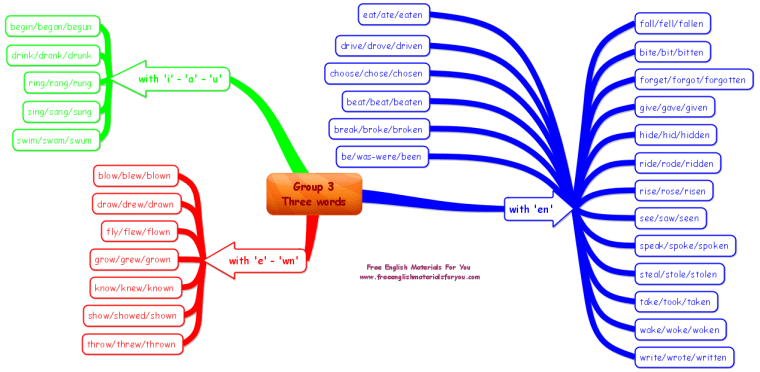
English Irregular Verbs - Group 3.png
GROUP 3 – THREE WORDS

  • WITH ‘EN’

    – be/was-were/been
    beat/beat/beaten
    – bite/bit/bitten
    – break/broke/broken
    – choose/chose/chosen
    – drive/drove/driven
    – eat/ate/eaten
    – forget/forgot/forgotten
    – give/gave/given
    – hide/hid/hidden
    – ride/rode/ridden
    – rise/rose/risen
    – see/saw/seen
    – speak/spoke/spoken
    – steal/stole/stolen
    – take/took/taken
    – wake/woke/woken
    – write/wrote/written 
  • WITH ‘E’ – ‘WN’

    – blow/blew/blown
    draw/drew/drawn

    – fly/flew/flown
    – grow/grew/grown
    – know/knew/known
    – show/showed/shown
    – throw/threw/thrown 
  • WITH ‘I’- ‘A’- ‘U’

    begin/began/begun
    – drink/drank/drunk
    – ring/rang/rung
    – sing/sang/sung
    – swim/swam/swum

I’ll upload soon some quizzes on this topic. 😉
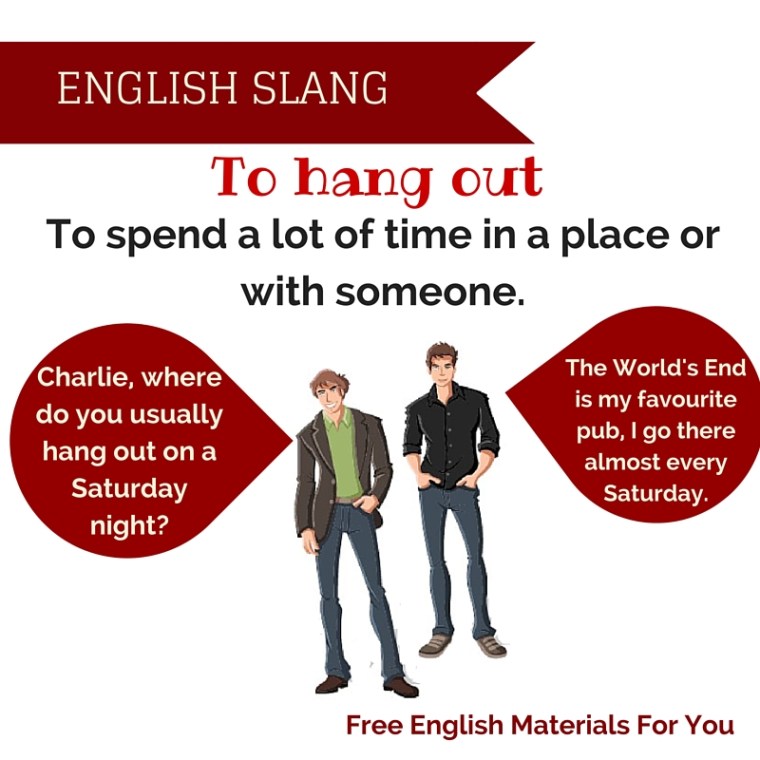
To hang out – English slang

ENGLISH IDIOM.jpg

Example sentences from the web:

  • Since he got a girlfriend he stopped hanging out with his friends.

  • Byron and some of the other poetic dudes are planning to hang out at Jack Straws before we go to sup. Like to join us?

  • You still hang out at the pool hall?

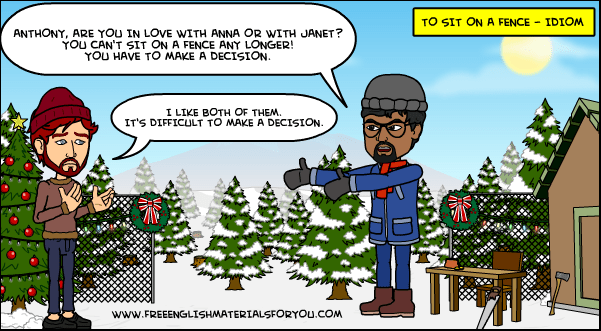
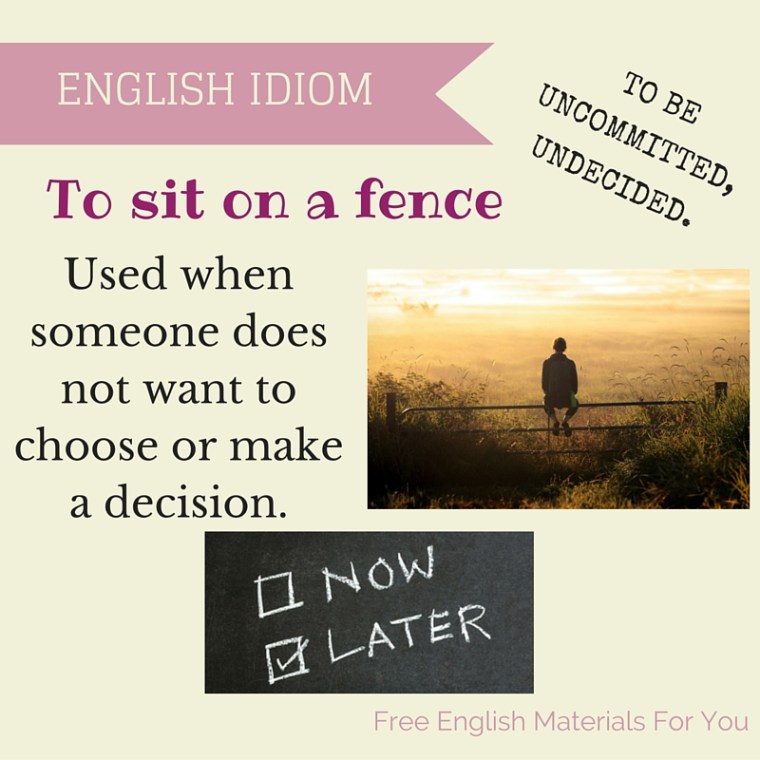
“To sit on a fence” – English idiom

TO SIT ON A FENCE.jpg

TO SIT ON A FENCE.png

Example sentences from the web:

  • No one knows which of the candidates Joan will vote for. She is sitting on the fence.

  • I am sitting on a fence here, to go or not to go?

  • Many customers are still on the fence waiting to see if a better, less expensive computer will come along.

As you can see in the last example sentence, a variation of this idiom is “to be on a/the fence“, with the same meaning.

Examples from the news:

  • Bond Market Just Sitting On The Fence – (New York Times, August 19, 1995)

  • In fact, I would think that he would get even more votes – from people who were sitting on the fence before […] (Yushchenko sitting pretty, BBC News, December 4, 2004).

  • “It is not a question of sitting on the fence,” he said. “This is an important decision and it’s important we get it right.” (Simon Wright in a corner on tuition fees, BBC News , November 3, 2010).


“To apologise” – What does it mean?

TO APOLOGISE

You can apologise:
– to someone
He apologised to his colleagues.
– for something
She apologised profusely for the damage she had caused.
– for doing something
They apologised for accusing her falsely.

– to someone for something
I must apologise to Jasmine for my lateness.

– to someone for doing something
He apologised to his wife and children for losing his temper.

“Apologize” – by Timbaland ft. One Republic

I’m holding on your rope, got me ten feet off the ground
And I’m hearing what you say, but I just can’t make a sound
You tell me that you need me then you go and cut me down, but wait
You tell me that you’re sorry, didn’t think I’d turn around, and say (that)

“It’s too late to apologize (it’s too late).”
I said, “It’s too late to apologize (it’s too late).”

I’d take another chance, take a fall, take a shot for you
And I need you like a heart needs a beat, but it’s nothin’ new (yeah)
I loved you with a fire red, now it’s turning blue, and you say,
“Sorry,” like the angel heaven let me think was you, but I’m afraid…

“It’s too late to apologize (it’s too late).”
I said, “It’s too late to apologize (it’s too late).”

“It’s too late to apologize (it’s too late).”
I said, “It’s too late to apologize (it’s too late).”

I said, “It’s too late to apologize,” yeah (too late)

I’m holdin’ on your rope, got me ten feet off the ground

A game on this song: LyricsTraining

An article on Wikipedia on spelling differences between British and American English: American and British English Spelling Differences.

PDF version for teachers (printable): To apologise

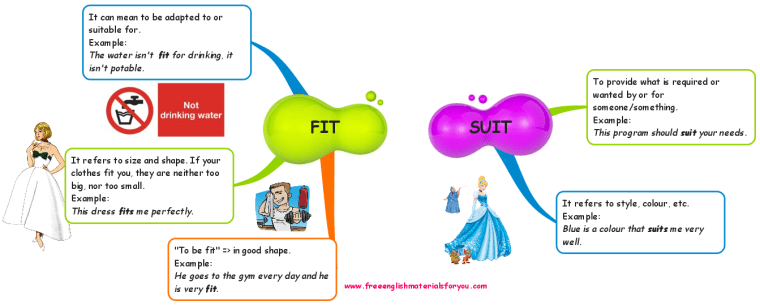
Difference between SUIT and FIT

30-11-2015-09-20-05


You can download this mind map (IMX file) here: Biggerplate

I don’t know why but I couldn’t upload the image like I usually do. That’s why it results so small and you can’t get the full-size version by clicking on it :-(. I’ll upload it on Facebook, so if you want to take a look, click on this link: Mind Maps .

HAPPY THANKSGIVING!!!

Do you know the origin of this celebration? If you don’t, watch this video and find out more about this topic!

VOCABULARY

TO WONDER = to have an interest in knowing or learning something; to think about something with curiosity.
TO MIND YOUR OWN BUSINESS => This phrase is used as an INFORMAL and often somewhat IMPOLITE way to tell someone to stop watching or asking about something that is private.
BEHOLD! (interjection)= look!; see!
TO BUMP= to collide with; to hit against an object in a sudden and forceful way.
Bump

WHATEVER (slang)
PILGRIM= a person who makes a journey, often a long and difficult one, to a special place for religious reasons.

pilgrims.jpg

Photo credit: Peter E. Lee / Foter.com / CC BY-NC

SETTLEMENT= a place where people have come to live and where few or no people lived before.
FARMER= a person who operates a farm or cultivates a land.

farmer

 Photo credit: jaci XIII / Foter.com / CC BY-NC-SA

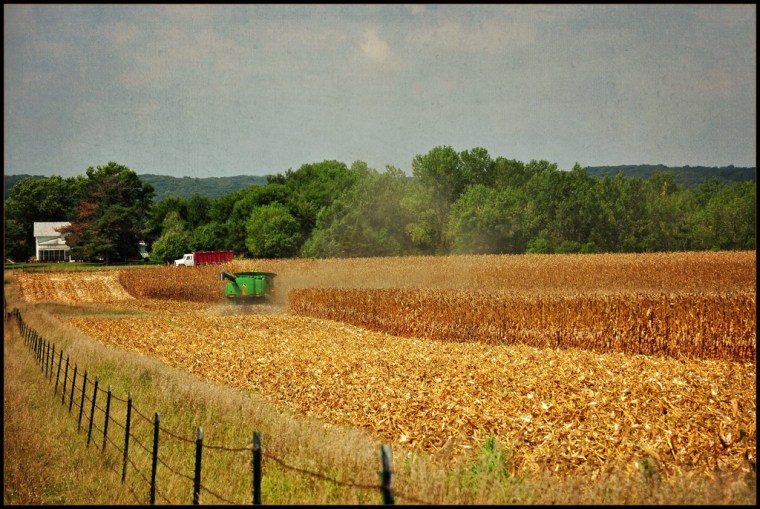
HARVEST= the season when crops are gathered from the fields or the activity of gathering crops.

harvest.jpg

 Photo credit: TumblingRun / Foter.com / CC BY-ND

BLESSING= approval that allows or helps you to do something.

Thanksgiving crossword puzzle
(printable or interactive)

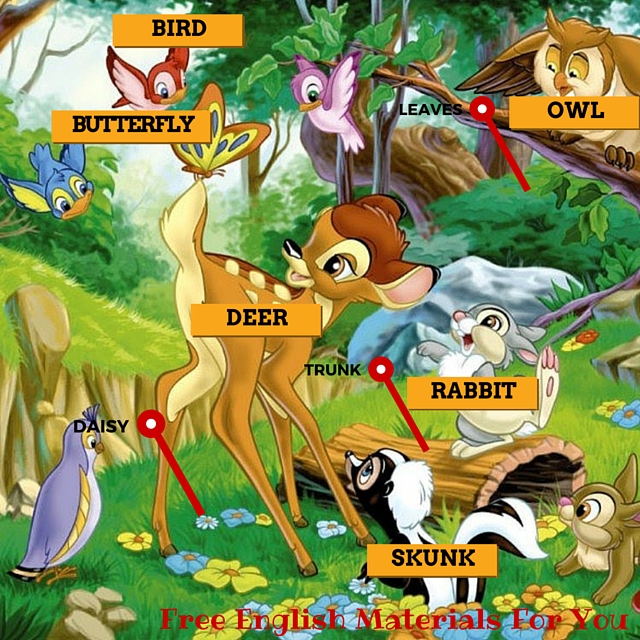
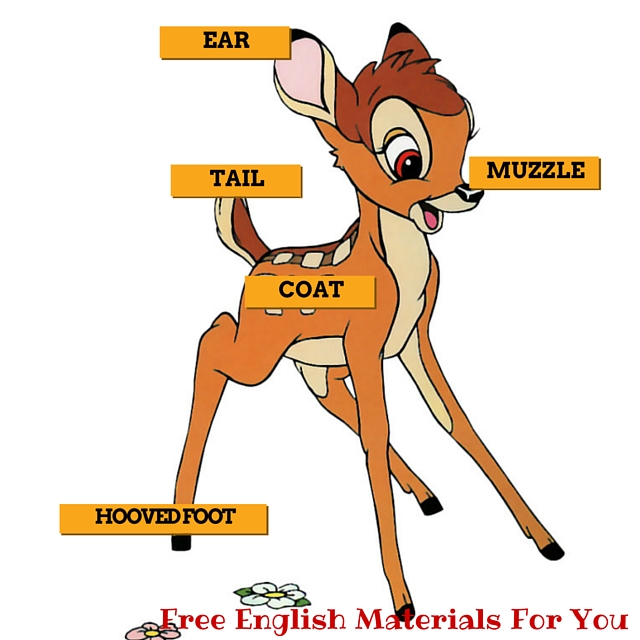
Visual Vocabulary 3

Landscape (2)

Image source

Bamby was exploring the forest  forest when he encountered a fallen log (trunk) tree-576846_1280.png. Thumper, the rabbit rabbit-551991_1920.jpg, decided to use this trunk to teach Bamby how to jumpfreedom-307791_1280.png. After that, Thumper taught Bamby to say “birdbird-548654_1280.png and “butterflybutterfly-142506_1280.jpg.

The simple past of the verb “to teach” is “taught”.

Remember that the plural of “butterfly” is “butterflies” and the singular of “leaves” is “leaf”.

Landscape (3).jpgImage source