What is the Zika Virus? – vocabulary, video, and exercises with answers.

I suggest that you read this list of words you may not know before watching the video.

VOCABULARY

To spread : to become larger or to affect a large area.
Ex. The fire spread through the six-storey building via the single staircase which acted as a chimney.

To detect : to discover or ascertain the existence.
Ex. 
Irregularities were detected on seven of the websites.

To break out : if something dangerous or unpleasant breaks out, it suddenly starts.
Ex. 
War broke out in 1914.

To transmit : to give or pass from one person to another; to cause (a virus, disease, etc.) to be given to.
Ex. 
Hepatitis C is a life-threatening viral disease transmitted primarily by blood contact.

To link : to make a connection between two or more things, ideas or people.

Paralysis : a condition in which you can’t move or feel al or part of your body.

Spike : a very high level.

Outbreak : a sudden increase, rise.

Mild : not strong in action or effect.

Vaccine : a substance injected into a person or animal to protect against a particular disease.

Downloadable PDF: What is the Zika Virus – vocabulary

Answer the following questions:

  1. How many people could be affected by Zika virus this year?

  2. Where was it discovered and when?

  3. Where did it break out in 2015?

  4. How is this virus transmitted?

  5. What are some of the effects of Zika virus?

  6. Is there a treatment for this virus?

  7. When could be ready a vaccine against Zika virus?

Fill in the gaps with the correct word from the box.
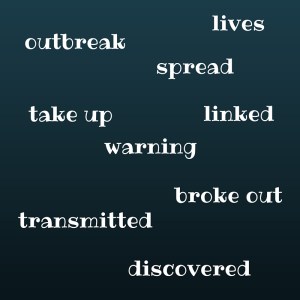
fill in the gaps


  1. Zika virus could _________ tofour million people this year.

  2. It was ____________ in Uganda in the 1940’s.

  3. It ______________ in the Americas and the Caribbean in 2015.

  4. Zika is _______________ through a particular species of mosquito that ______________ mostly in tropical regions.

  5. Zika has been _______________ to paralysis and birth defects.

  6. Officials are now _____________ pregnant women not to travel to places where there is an active Zika ___________.

  7. Officials say finding a vaccine could _____________ to a decade.

Downoadable PDF: What is the Zika Virus – exercises

Downloadable PDF: What is the Zika Virus – correct answers

 

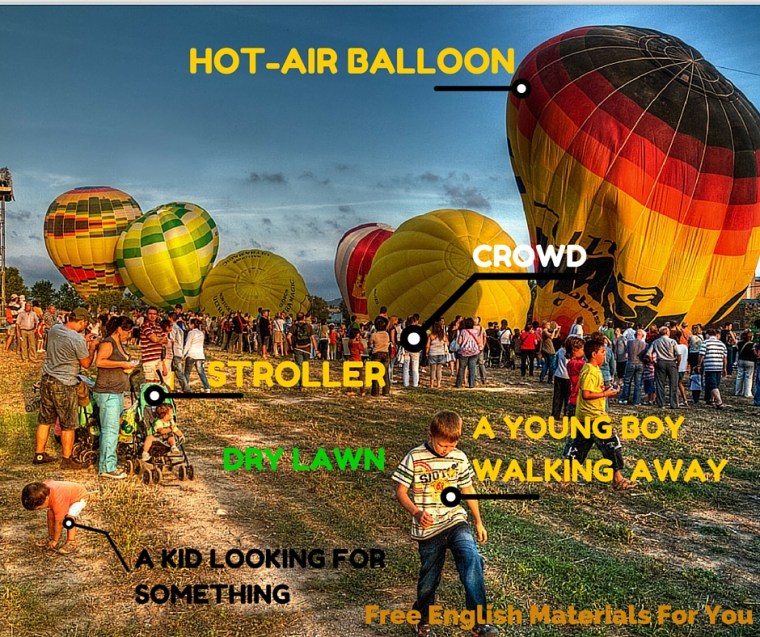
Visual vocabulary 6

VISUAL VOCABULARY (1).jpg

Photo credit: Paco CT via Foter.com / CC BY-NC-SA

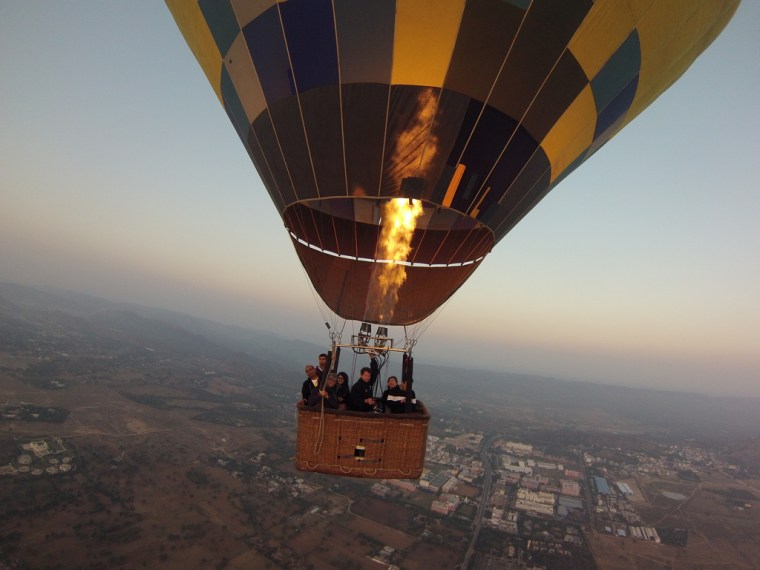
HOT-AIR BALLOON =>  a lighter-than-air craft in which air heated by a flame is trapped in large fabric bag. Hanging under the balloon, there is a basket (container) in which people can ride.
In this picture, you can notice that there are seven people in the  basket and the flame is visible because they are flying:

Hot-air balloon

Photo credit: Arun Katiyar via Foter.com / CC BY-SA

The first hot-air balloon was created in 1783 by two brothers, Joseph-Michel and Jacques-Ètienne Montgolfier. 

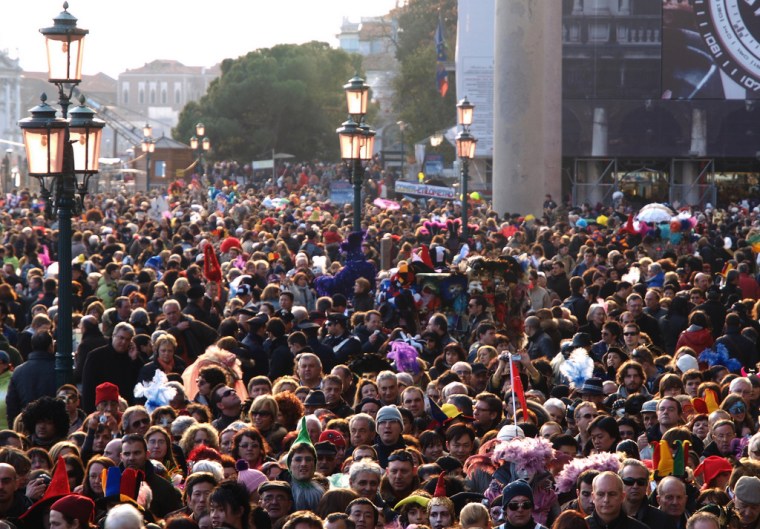
CROWD => a large group of people. This is a crowd:

Crowd meaning.jpg
Photo credit: mararie via Foter.com / CC BY-SA

LAWN => grass-covered land.
In this picture, the lawn is dry, probably because it didn’t rain for a while (the grass isn’t green).

dry lawn.jpg
Photo credit: mugley via Foter.com / CC BY-NC-ND

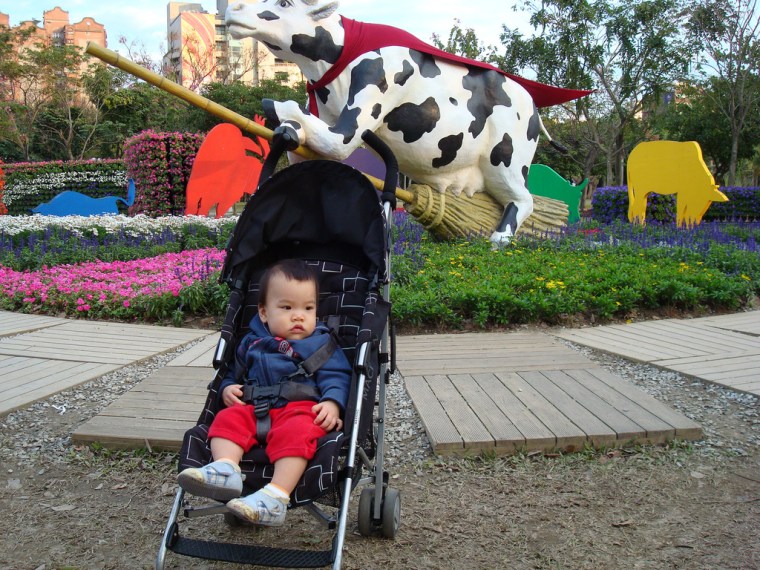
STROLLER => a small carriage with four wheels that a baby or small child can ride in while someone pushes it.

Stroller mening.jpg

Photo credit: alberth2 via Foter.com / CC BY-SA

Irregular verbs

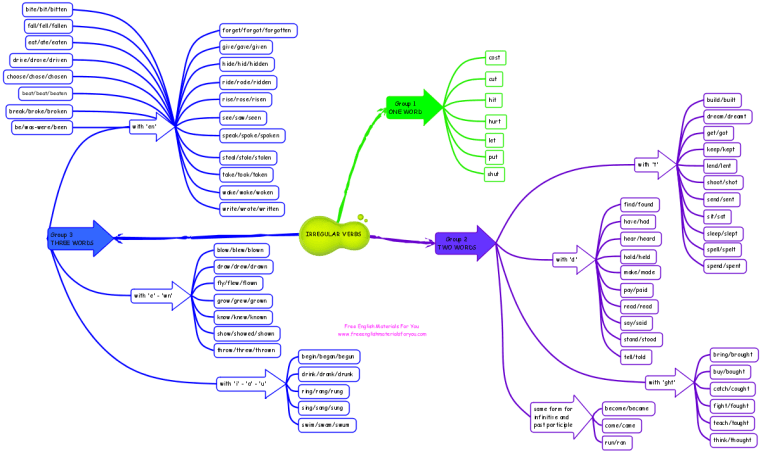
It’s since a while that I am not uploading posts on grammar. In my opinion, for a beginner is not so easy to memorize irregular verbs, that’s why I decided to make mind maps and other resources on this topic. I hope you’ll find it useful.
Irregular verbs in English - mind map

You can download this mind map on Biggerplate (imx file). If you don’t have the possibility to open this kind of file, just download the image from Free English Materials’ Facebook Page (Album: Mind maps)

Since there are a lot of irregular verbs I decided to make smaller mind maps for each single group. In this way, it will be easier for you to read them.

Group one - one word

GROUP 1 – ONE WORD

  • cut
  • cost
  • hit
  • hurt
  • let
  • put
  • shut

Group two- two words

GROUP 2 – TWO WORDS

  • WITH ‘T’

    build/built
    – dream/dreamt
    – get/got
    – keep/kept
    – lend/lent
    – shoot/shot
    – send/sent
    – sit/sat
    – sleep/slept
    – spell/spelt
    – spend/spent

  • WITH ‘GHT’

    bring/brought
    – buy/bought
    – catch/caught
    – fight/fought
    – teach/taught
    – think/thought

  • WITH ‘D’

    – find/found
    – have/had
    – hear/heard
    – hold/held
    – make/made
    – pay/paid
    – read/read
    – say/said
    – stand/stood
    – tell/ told

  • SAME FORM FOR INFINITIVE AND PAST PARTICIPLE

    become/became
    – come/came
    – run/ran

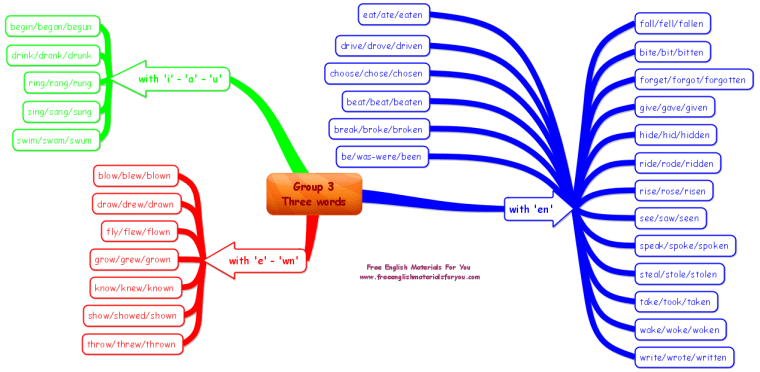
English Irregular Verbs - Group 3.png
GROUP 3 – THREE WORDS

  • WITH ‘EN’

    – be/was-were/been
    beat/beat/beaten
    – bite/bit/bitten
    – break/broke/broken
    – choose/chose/chosen
    – drive/drove/driven
    – eat/ate/eaten
    – forget/forgot/forgotten
    – give/gave/given
    – hide/hid/hidden
    – ride/rode/ridden
    – rise/rose/risen
    – see/saw/seen
    – speak/spoke/spoken
    – steal/stole/stolen
    – take/took/taken
    – wake/woke/woken
    – write/wrote/written 
  • WITH ‘E’ – ‘WN’

    – blow/blew/blown
    draw/drew/drawn

    – fly/flew/flown
    – grow/grew/grown
    – know/knew/known
    – show/showed/shown
    – throw/threw/thrown 
  • WITH ‘I’- ‘A’- ‘U’

    begin/began/begun
    – drink/drank/drunk
    – ring/rang/rung
    – sing/sang/sung
    – swim/swam/swum

I’ll upload soon some quizzes on this topic. 😉

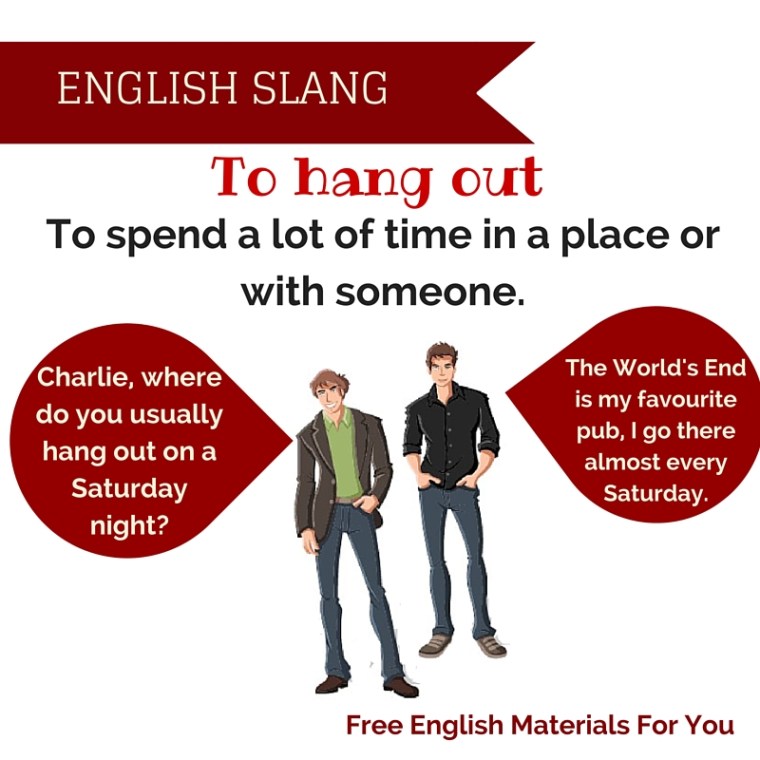
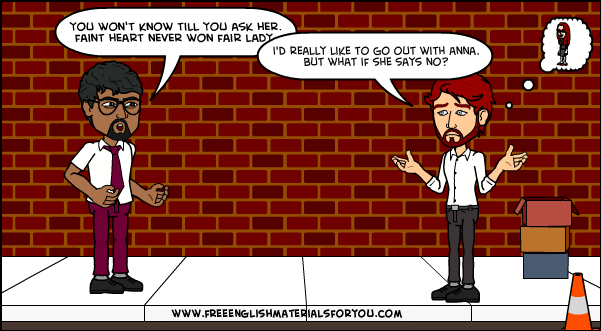
To hang out – English slang

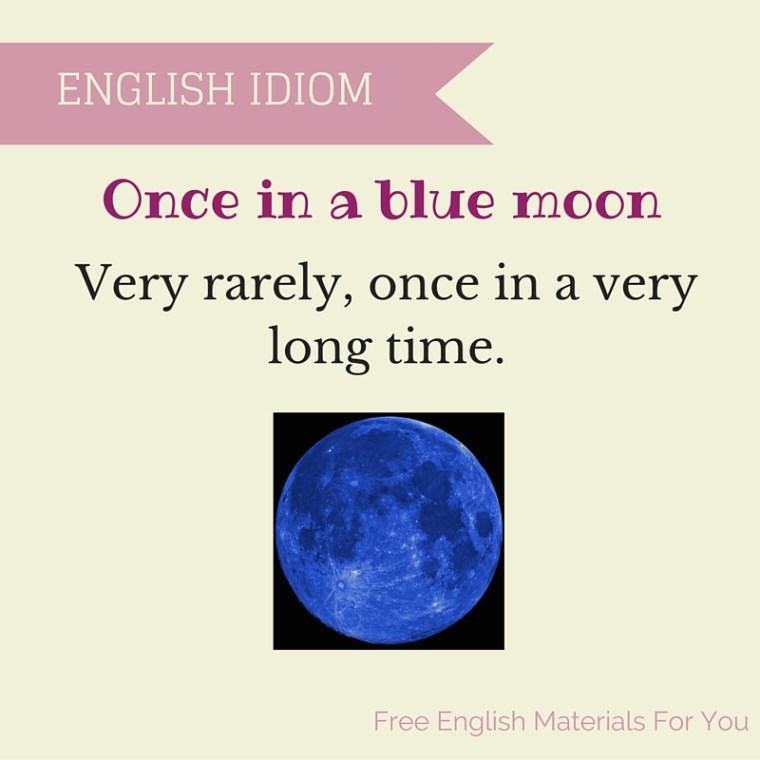
ENGLISH IDIOM.jpg

Example sentences from the web:

  • Since he got a girlfriend he stopped hanging out with his friends.

  • Byron and some of the other poetic dudes are planning to hang out at Jack Straws before we go to sup. Like to join us?

  • You still hang out at the pool hall?

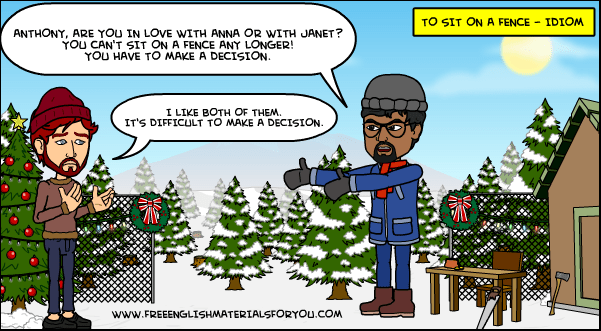
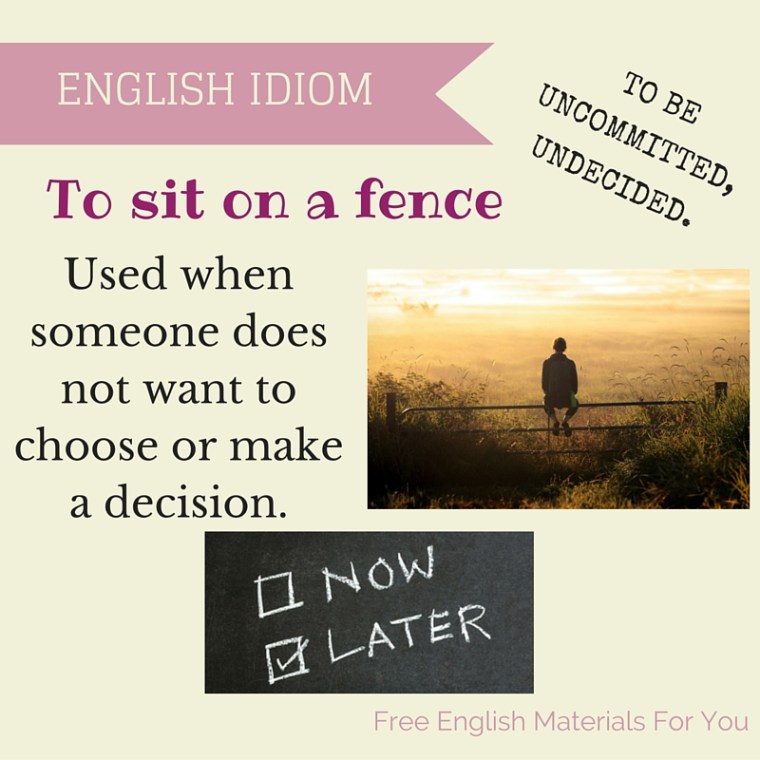
“To sit on a fence” – English idiom

TO SIT ON A FENCE.jpg

TO SIT ON A FENCE.png

Example sentences from the web:

  • No one knows which of the candidates Joan will vote for. She is sitting on the fence.

  • I am sitting on a fence here, to go or not to go?

  • Many customers are still on the fence waiting to see if a better, less expensive computer will come along.

As you can see in the last example sentence, a variation of this idiom is “to be on a/the fence“, with the same meaning.

Examples from the news:

  • Bond Market Just Sitting On The Fence – (New York Times, August 19, 1995)

  • In fact, I would think that he would get even more votes – from people who were sitting on the fence before […] (Yushchenko sitting pretty, BBC News, December 4, 2004).

  • “It is not a question of sitting on the fence,” he said. “This is an important decision and it’s important we get it right.” (Simon Wright in a corner on tuition fees, BBC News , November 3, 2010).


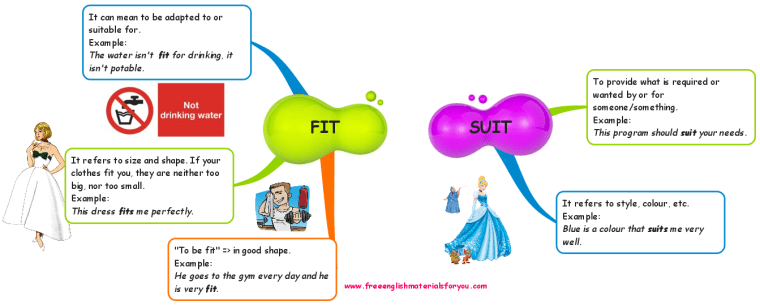
Difference between SUIT and FIT

30-11-2015-09-20-05


You can download this mind map (IMX file) here: Biggerplate

I don’t know why but I couldn’t upload the image like I usually do. That’s why it results so small and you can’t get the full-size version by clicking on it :-(. I’ll upload it on Facebook, so if you want to take a look, click on this link: Mind Maps .